
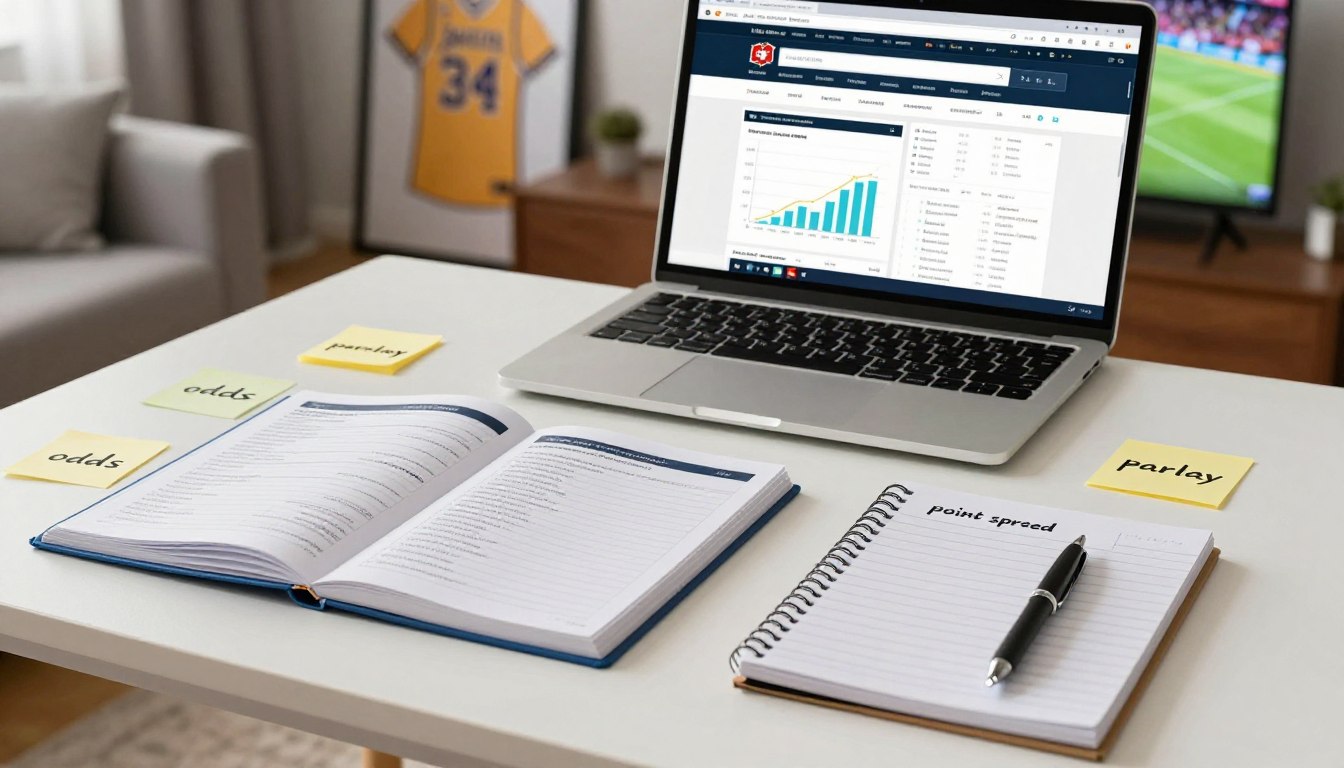
Placing a wager on a game is a tradition as old as competition itself. For generations, fans have added excitement by predicting event outcomes. This long history has created a unique language between participants and bookmakers.
When you’re new, this specialized lexicon can seem intimidating. It’s like learning the rules of a sport you’ve never watched. You must understand the basic plays before you can fully enjoy the event.
This guide is here to demystify that language. We provide a clear, accessible glossary of essential phrases every newcomer needs. Understanding these terms is the first critical step toward making informed decisions with your money.
We’ll start with foundational concepts like the point spread and moneyline. The article will then explore more advanced market dynamics. By the finish, you’ll confidently use key terms like “parlay” and understand how odds work.
Introduction to Sports Betting Terminology
Before you place your first stake, you must decode the essential phrases that form the backbone of every market discussion. This unique jargon is the shared code between participants and bookmakers.
Without it, you’re navigating in the dark. Mastering this lexicon is your ticket from observer to informed participant.
Why Learning the Lingo Matters
Misunderstanding a single term can lead to a costly error. Clear communication prevents you from accidentally making the wrong type of wager.
Precise language allows you to analyze markets effectively. You can discuss strategies accurately with other bettors and understand sportsbook offerings.
Knowledge of phrases like “vig” directly impacts your bottom line. It lets you calculate true potential payouts and the real cost of any odds.
How to Use This Glossary
Bookmark this page for quick reference. Focus first on sections about the game formats you enjoy most.
Don’t just memorize definitions. Understand the context, like how “futures” work for long-term predictions.
A great practical tip is to open a real sportsbook app. Follow along to see these terms in a live setting.
This foundational knowledge builds immense confidence. It transforms a novice into a savvy market participant.
The guide is organized logically. It starts with simple concepts and builds to more advanced ones.
| Term | Simple Definition | Why It Matters |
|---|---|---|
| Point Spread | A handicap added to a game to create balanced odds. | You learn to bet on a team’s performance margin, not just who wins. |
| Moneyline | A straightforward bet on which side will win the event. | It’s the simplest wager type, perfect for starting out. |
| Vig/Juice | The commission built into the odds by the sportsbook. | Knowing this shows you the true cost of placing a bet. |
| ATS (Against the Spread) | Refers to whether a team covered the point spread. | This is the key metric for determining if your spread bet won. |
Using this table as an example, you see how each term connects to a real advantage. This practical understanding gives you a better chance from the start.
Core Bet Types: The Basics of Wagering
Every market revolves around a core set of wager formats that dictate how you predict outcomes. Once you know these, you can approach any contest with clarity.
The three essential formats are the point spread, moneyline, and over/under. These are the pillars of the activity.
Point Spread (Spread)
The point spread is a handicap designed to level the playing field. It makes both sides of a game attractive when teams have different perceived strength.
You will see it listed as a number with a plus or minus sign. For example, “Patriots -6.5” means New England is favored to win by 6.5 points.
The opposing team, like “Jets +6.5”, gets a 6.5-point head start. To win a bet on the favorite, they must win by more than that number.
A team “covers the spread” when it beats the handicap. If the favorite wins by exactly 6.5 points, it’s a push, and stakes are returned.
Moneyline
This is the simplest bet type. You pick which side will win the event, with no points involved.
Odds indicate the favorite (negative number) and the underdog (positive number). The numbers show how much money you need to risk or can win.
For example, a -150 line means you must risk $150 to profit $100. A +200 underdog returns a $200 profit on a $100 stake.
It’s a direct wager on the winner. This format is common in baseball and hockey.
Over/Under (Total)
Also called the total, this bet focuses on the combined score of both teams. The game’s final victor does not matter.
A sportsbook sets a projected number. You predict if the actual score will be over or under that figure.
In basketball, a total might be 221.5. In football, it could be 47.5. You are betting on the pace and offensive output.
This wager is about the flow of the contest. It’s ideal when you have a feel for the scoring environment.
| Bet Type | Simple Explanation | Key Example | Best Used When |
|---|---|---|---|
| Point Spread | A handicap added to the score to create balanced odds. | Cowboys -3.5 vs. Eagles +3.5 | The matchup seems balanced, and you want to bet on a margin of victory. |
| Moneyline | A direct bet on which team will win the game outright. | Lakers -180 / Grizzlies +150 | You have a strong conviction on who will win, regardless of points. |
| Over/Under (Total) | A wager on whether the combined score will be over or under a set number. | NBA Game Total: 228.5 | You are focused on game flow and scoring potential, not the winner. |
Let’s look at real example scenarios. Imagine an NFL game with the Chiefs favored by 7 points.
If you believe Kansas City will win by more than a touchdown, you take the point spread. A moneyline bet is for simply backing them to win.
If you expect a shootout, the over/under total might be your play. Each format serves a different strategic purpose.
Beginners should start with moneylines for simplicity. Spreads and totals offer more nuanced ways to engage with the market.
Advanced Wagers: Parlays and Combinations
For those seeking bigger payouts from a smaller stake, combining multiple outcomes into a single ticket is a common strategy. These advanced plays offer exciting potential but come with significantly higher risk.
Understanding how these combinations work is crucial before you place one. They are not for every situation or bankroll.
Parlay Bet
A parlay is one wager that links two or more individual selections, called “legs.” For the entire bet to win, every single leg must be correct.
The appeal is mathematical. Instead of adding, the odds for each leg multiply together. This creates a much larger potential payout than placing the bets separately.
The trade-off is stark. Your chance of success drops with each added leg. One wrong pick loses the whole ticket. You can combine picks from different teams and even different sports.
Same-Game Parlay
The Same-Game Parlay (SGP) is a hugely popular modern twist. It lets you string together multiple outcomes from a single contest.
You might combine a team’s point spread, a player prop, and the over/under total. All predictions must hit for the SGP to pay.
Here’s a detailed example for an NFL game. Your SGP could include: 1) 49ers -3.5, 2) Christian McCaffrey to score a touchdown anytime, and 3) Over 48.5 total points. This builds a narrative around one event.
Teaser
A teaser is a specialized type of parlay. It allows you to adjust the point spreads or totals in your favor by a fixed number of points.
In football, a common teaser moves the line by 6 or 6.5 points. You must select multiple teams, and all adjusted legs must still win.
The trade-off is clear. You get better spreads, but the odds and potential payout are much lower than a standard parlay. The sportsbook gives you help but charges for it.
These advanced combinations are high-risk. They should only command a small part of your bankroll. Beginners are advised to master single bets first.
To see how odds combine, you can use tools to calculate parlay payouts.
| Wager Type | How It Works | Key Trade-Off | Example Scenario |
|---|---|---|---|
| Parlay | Combines 2+ picks into one ticket. All must win. | High potential payout vs. rapidly decreasing chance of success. | A 3-team parlay on the moneyline winners of an NBA, MLB, and NHL game. |
| Same-Game Parlay (SGP) | Links multiple bet types from one event into a single parlay. | Allows creative narratives for one contest, but still all-or-nothing. | An SGP on an NFL game: Team A wins, Quarterback throws over 250 yards, and the game goes Over the total. |
| Teaser | A parlay where you adjust point spreads/totals in your favor. | Better point spreads but significantly reduced odds/payouts. | A 2-team, 6-point NFL teaser moving a -7.5 favorite to -1.5 and a +3.5 underdog to +9.5. |
Each of these plays serves a different market need. The parlay chases a big score. The SGP focuses excitement on one game. The teaser buys insurance on spreads.
Use them sparingly and with full understanding of the math. Over time, the high house edge on these bets can be costly.
Proposition Bets: Beyond the Final Score
Imagine wagering on whether a specific player will score a touchdown before the game even starts. This is the world of proposition bets, or props. They let you focus on specific occurrences within a contest, not just the final outcome.
These wager types create a “game within a game.” They extend far beyond spreads, totals, and moneylines. You can target almost any aspect of the action.
Props add a unique layer of engagement. They require you to analyze different elements of the event. This opens up many new market opportunities.
Prop Bet (Proposition Bet)
A proposition bet is any wager on a specific occurrence not directly tied to the final score or spread. It’s a broad category. The term “prop” covers a huge range of possibilities.
You are not just picking a winner. You are predicting a precise detail. This could involve an individual’s performance or a specific game moment.
These bets are graded based on official statistics and recorded events. The result must be clear and measurable. This ensures fairness for everyone involved.
Player Props
Player props focus on an individual athlete’s statistical performance. You are betting on a single person’s output, not their team’s result.
Common markets are everywhere. In football, you might see “Over/Under 289.5 passing yards” for a quarterback. Basketball offers “Over/Under 24.5 points + rebounds + assists” for a star.
Hockey could feature shots on goal totals. The prop line is set as an Over/Under number. You predict if the player will go above or below that figure.
Official league stats determine the grade. If a quarterback throws for 300 yards, the “Over 289.5” bet wins. This requires focusing on individual matchups and recent form.
Game Props
Game props target specific occurrences within the contest not tied to one player. They are about events that shape the flow of the event.
Classic examples include “Which team will score first?” or “Will the game go to overtime?” Others are “Total touchdowns scored” or “Margin of victory.”
These props often have yes/no or multiple-choice formats. They analyze coaching tendencies and situational factors. Weather or a team’s opening script can be key.
Major events like the Super Bowl feature hundreds of creative prop bets. These can range from the coin toss to the length of the national anthem. It’s a festive part of the experience.
| Prop Type | Primary Focus | Common Examples | Key Analysis Tip |
|---|---|---|---|
| Player Props | Individual athlete performance and statistics. | Passing yards (QB), Points+Rebounds+Assists (NBA), Shots on Goal (NHL). | Study head-to-head matchups, recent trends, and role changes. Injury reports are crucial. |
| Game Props | Specific occurrences or milestones within the contest itself. | First team to score, Total touchdowns, Will the game go to Overtime?, Margin of victory. | Consider coaching tendencies, opening scripts, and situational factors like weather or venue. |
Prop betting requires a different kind of analysis. You must look beyond overall team strength. Individual matchups and specific game plans matter more.
It offers a great chance to use specialized knowledge. Maybe you know a player excels in certain conditions. That insight can guide your pick.
Beginners should start with straightforward props. Focus on one clear stat, like a quarterback’s passing yards. This is better than exploring niche markets right away.
Take your time to understand how these lines are set. Start with one or two simple props per game. This builds confidence without overwhelming you.
Futures Bets: Long-Term Predictions
Season-long narratives and championship dreams form the basis of a unique category of wagers that test your forecasting skills over months. This activity is about predicting the final chapter of a story that has yet to be written.
Unlike a bet on tonight’s game, these predictions are settled far in the future. They require patience and a broader view of how a team or player will perform across an entire campaign.
Futures Bet
A futures bet is a wager placed on an outcome that will be decided at the conclusion of a season or tournament. Your money is committed for a long time, often several months.
Common examples include:
- Picking a team to win the Super Bowl or NBA Finals.
- Selecting the champion of the World Series or Stanley Cup.
- Backing a player to win a major award like MVP or the Cy Young.
The odds can be very long, offering high potential payouts for correct underdog picks. The trade-off is clear. Your funds are locked up until the event concludes.
Win Total
A win total is a specific and popular type of futures market. The sportsbook sets a line for how many games a team will win in the regular season.
You then bet on whether the final count will be over or under that number. For example, an NFL club might have a win total set at 9.5.
If you take the “Over,” you need them to secure at least 10 victories. It’s a direct bet on a team’s consistency and strength across the full schedule.
One key strategic aspect is “buying low.” This means backing a club with long odds early if you believe in their potential. A smart pick at the right time can yield a great payout.
These odds are not static. They shift constantly based on game results, injuries, and trades. This creates a dynamic market where value can appear or disappear.
| Market Type | What You’re Predicting | Typical Settlement | Strategic Consideration |
|---|---|---|---|
| Championship Futures | A team or player winning a specific title or award at season’s end. | After the final championship event (e.g., the Super Bowl, Game 7 of the Finals). | Look for teams with strong off-season moves or undervalued rosters before the season starts. |
| Season Win Totals | Whether a team will finish with more or fewer wins than a set number. | After the regular season concludes, when final win counts are official. | Analyze schedule difficulty, division strength, and coaching stability when evaluating the line. |
Bankroll management is crucial here. Experts advise that futures should only be a small part of your portfolio. The long lock-up period limits your flexibility with those funds.
Consider a real-world example. An MLB club might be +2500 to win the World Series in March. If they start strong, those odds could shrink to +800 by the All-Star break.
This shows how chance and perception shift the market. Your early bet gains value if the team meets expectations.
Use these long-term predictions to back your deepest convictions. Just remember to stake only what you can afford to leave untouched for months.
In-Game Action: Live Betting Terms
Modern technology has transformed watching a contest into an interactive experience. Every play can shift the landscape of opportunity in real time. This is the dynamic world of in-play action.
Two powerful tools define this space: live betting and the cashout option. Understanding them turns you from a passive viewer into an active participant. You can react to the unfolding drama of the event.
Live Betting (In-Game Wagering)
Live betting, also called in-play wagering, lets you place a bet after a game has started. The odds update constantly based on the live action on the field or court.
This creates a fluid market. You are not limited to pre-game predictions. You can target moments as they happen.
Dynamic markets include many possibilities. You can wager on the result of the next at-bat or which team wins the current quarter.
Adjusted point spreads and totals are also common. The line moves with the score and momentum. This allows for strategic reactions.
The advantages are clear. You can react to visible momentum shifts or a key player injury after kickoff. It lets you use information that wasn’t available before the opening whistle.
Remember when Patrick Mahomes leads a comeback? That’s live betting magic. It’s not just about picking winners. Exploring different bet types with real-life shows it’s a chess match with odds.
Cashout Option
The cashout option is a related feature offered by many operators. It allows you to settle a wager before the event concludes. You can secure a guaranteed profit or cut a loss early.
This gives you control over your money during the contest. You are not locked in until the final whistle.
Cashout values are calculated automatically. The sportsbook uses current live odds and the probability of your bet winning. The offer reflects the perceived chance of success at that moment.
Strategic uses are important. You can lock in profit on a likely winner that becomes less certain. Imagine your team takes an early lead but their star gets hurt.
You might also minimize losses on a bet that is turning sour. Cashing out early can salvage some of your stake. This is better than a total loss.
A key warning is necessary. Cashout offers are usually designed to benefit the operator’s margin. They may not always represent fair value for your bet.
The sportsbook builds a buffer into the price. Always consider if letting the wager ride offers better expected value.
| Feature | How It Works | Primary Strategic Use | Important Consideration |
|---|---|---|---|
| Live Betting | Placing bets in real-time as the game progresses, with odds updating dynamically. | Capitalizing on in-game momentum shifts, injuries, or tactical changes you can see. | Decisions must be quick. Odds can change between the time you click and when your bet is placed. |
| Cashout Option | Settling an active bet early for a predetermined amount, before the final outcome. | Risk management: securing a partial profit or reducing a potential loss based on new information. | The offered cashout value typically includes a margin favoring the book, so it’s often less than the true expected value. |
Let’s walk through a step-by-step example from a soccer match.
- Pre-game: You bet $100 on Team A to win at +150 odds. A $250 total payout is possible.
- Live Action: Team A scores early, leading 1-0 at halftime. Their live moneyline odds shift to -200.
- Cashout Offer: Based on the new high probability of victory, the operator offers you a $180 cashout.
- Decision: You accept the cashout, guaranteeing an $80 profit. Team A later concedes a tying goal, and the match ends 1-1. Your original bet would have lost, but you secured money.
This example shows the power and caution required. These tools offer incredible strategic flexibility. They also demand disciplined decision-making in real time.
Understanding Betting Odds and Formats
Every wager is framed by a set of numbers that communicate two vital pieces of information: how likely something is to happen, and what you’ll earn if it does.
These numbers are called odds. They are the universal language between you and the sportsbook.
Mastering this language lets you calculate potential payouts instantly. It also reveals the implied probability the bookmaker assigns to each outcome.
There are three main formats used globally. You will encounter American, Decimal, and Fractional odds. Each presents the same fundamental math in a different way.
Understanding all three makes you a versatile participant. You can navigate any sportsbook, domestic or international.
American Odds
American odds, also called moneyline odds, are the standard in the United States. They are displayed with a plus (+) or minus (-) sign.
The sign tells you everything. Negative numbers indicate the favorite. Positive numbers represent the underdog.
Here is the simple rule. Negative odds show how much you must risk to win $100.
For example, a line of -150 means you need to bet $150 to profit $100. Your total return would be $250.
Positive odds show how much you win on a $100 risk. A line of +200 means a $100 bet profits $200, returning $300 total.
You can convert these odds to implied probability. For negative odds (-150), use this formula: (150 / (150 + 100)) * 100 = 60%. The sportsbook implies a 60% chance of that outcome.
For positive odds (+200), the formula is: (100 / (200 + 100)) * 100 = 33.3%. This implies a 33.3% probability.
Decimal Odds
Decimal odds are common in Europe, Canada, and Australia. They are praised for their simplicity.
These odds are represented by numbers like 1.50, 2.75, or 4.00. The calculation is straightforward.
Your total payout equals your stake multiplied by the decimal number. There is no separate calculation for profit.
For example, a $100 wager at decimal odds of 2.75 would return $275. This includes your original $100 stake plus $175 in profit.
You can easily compare this to American odds. The common American odds of -110 convert to roughly 1.91 in decimal format.
To find implied probability with decimals, divide 1 by the decimal odds. For 2.75: 1 / 2.75 = 0.3636, or a 36.36% implied probability.
Fractional Odds
Fractional odds are the traditional format in UK horse racing. They are shown as fractions, like 5/1 or 1/4.
The numerator (top number) shows your potential profit. The denominator (bottom number) represents your stake.
For example, odds of 5/1 mean a $1 stake profits $5. Your total return would be $6.
Odds of 1/4 indicate a heavy favorite. You would need to stake $4 to profit $1, for a total return of $5.
Converting fractional odds to implied probability uses this formula: Denominator / (Denominator + Numerator) * 100.
For 5/1: 1 / (1 + 5) * 100 = 16.67% probability. For 1/4: 4 / (4 + 1) * 100 = 80% probability.
| Format | Example | Potential Payout on $100 Stake | Implied Probability | Primary Region |
|---|---|---|---|---|
| American (Moneyline) | -150 / +200 | Profit $66.67 / Profit $200 | 60% / 33.3% | United States |
| Decimal | 1.67 / 3.00 | Total Return $167 / Total Return $300 | 59.9% / 33.3% | Europe, Canada, Australia |
| Fractional | 2/3 / 2/1 | Profit $66.67 / Profit $200 | 60% / 33.3% | United Kingdom (Horse Racing) |
Knowing how to convert between formats is a powerful skill. It allows you to shop for the best value across different platforms.
The basic formulas are simple. To convert American to Decimal:
- For positive odds: (American odds / 100) + 1.
- For negative odds: (100 / |American odds|) + 1.
For example, +200 becomes (200/100)+1 = 3.00. -150 becomes (100/150)+1 = 1.667.
Always take a moment to understand which format you’re viewing. This prevents confusion when calculating your potential money.
This knowledge turns abstract numbers into clear financial expectations. It is the final, essential layer of understanding before you place any type of wager.
Sportsbook Operations: Key Concepts
Behind every set of odds and available market lies a sophisticated operational engine. This engine is designed to ensure the sportsbook‘s long-term viability. Understanding these mechanics makes you a more informed participant.
These concepts explain how the house manages risk and profit. They directly impact the cost and availability of your wagers. Let’s explore the key terms that power this engine.

Vig (Juice) and Hold
The vig, or juice, is the sportsbook‘s built-in commission. It’s the price you pay for the chance to place a bet.
You see it in standard odds like -110 on a point spread. This means you must risk $110 to win $100.
The vig ensures the bookmaker profits regardless of the event’s outcome. They offer odds that total more than 100% probability.
This built-in margin is their financial safeguard. Hold is the related theoretical profit percentage. It’s the share of the total handle the sportsbook expects to keep over time.
Handle
The handle is the total sum of all money wagered on a particular event. It can also refer to the total across the entire sportsbook for a period.
This is a key metric of market size and interest. A large handle on the Super Bowl shows massive public engagement.
It indicates where the action is. For the operator, it’s a measure of volume and potential revenue.
Limit and Off the Board
Betting limits are the maximum amount a sportsbook will accept on a given wager. These limits protect the book from excessive risk.
Limits can vary based on the bettor‘s history, the event, or the specific market. A new customer might have a lower limit than a proven one.
“Off the board” (OTB) means a market has been temporarily removed. The sportsbook stops accepting wagers on that line.
This often happens due to breaking news. A star player‘s unexpected injury is a common cause. It creates too much uncertainty for the book to set a fair line.
| Concept | Definition | Impact on Bettor |
|---|---|---|
| Vig/Juice | The commission built into the odds; the cost of placing a bet. | Directly reduces potential payout. Understanding it reveals the true price of a wager. |
| Handle | The total amount of money wagered on an event or market. | Indicates market interest and liquidity. A large handle often means more stable lines. |
| Betting Limit | The maximum wager amount a sportsbook will accept. | Restricts the size of a single bet, affecting bankroll strategy for high-stakes players. |
| Off the Board | When a sportsbook suspends betting on a market. | Removes the opportunity to bet on that specific outcome until the line is reposted. |
Consider a real-world example. A sharp bettor identifies value in an NFL game.
They attempt to place a very large bet on one side. First, they might hit the sportsbook‘s maximum limit for that market.
Their substantial action could also cause the line to move quickly. If the news driving their bet is major, the book may take the entire game off the board.
This protects them from imbalanced risk. These operational concepts shape your entire experience. From the cost (vig) to the very availability of odds (OTB), the house mechanics are always at work.
Betting Outcomes and Results
Knowing how to read a final score is one thing. Understanding what it means for your ticket is another skill entirely.
The moment a contest ends, specific terms determine if you won, lost, or get your money back. These final verdicts are the core of the experience.
Mastering this vocabulary prepares you for every possible finish. It turns a simple score into a clear financial result.
Cover (Against the Spread)
When a team covers the spread, it beats the handicap set by the sportsbook. This is the key metric for spread wagers.
A favorite must win by more than the spread number. For example, if a team is -6.5, they need a victory margin of 7 points or more.
An underdog covers by winning outright or losing by fewer points than the spread. With a +6.5 line, they can lose by 6 or less.
What if the underdog loses by exactly 6.5 points? That is not a cover. It results in a different outcome called a push.
Push
A push occurs when the final result lands exactly on the betting number. It’s a tie between your wager and the line.
All stakes are refunded in full. You neither win nor lose your money.
Sportsbooks often use “hooks” to avoid pushes. A hook is a half-point added to common numbers.
Instead of a spread of -3, you’ll see -3.5. This eliminates the chance of a tie. It forces a decisive win or loss for every bet.
Bad Beat and Backdoor Cover
A bad beat is a soul-crushing loss on a bet that seemed certain to win. It happens from a last-second, improbable event.
Classic examples include a fumble returned for a touchdown as time expires. This can change the spread outcome in an instant.
The opposite phenomenon is a backdoor cover. A team scores meaningless late points to sneak inside the spread.
This turns likely losses for some into pushes or surprise wins. It’s a lucky break for those on the right side.
These outcomes are inherent parts of the variance in this activity. Understanding them helps you mentally prepare for inevitable swings.
| Term | Definition | Emotional Impact | Bankroll Effect |
|---|---|---|---|
| Cover (ATS) | Beating the point spread handicap. | Satisfaction of a correct prediction. | Full profit payout. |
| Push | Result lands exactly on the betting number. | Neutral relief; no gain or loss. | Full stake refunded. |
| Bad Beat | A near-certain win turns into a loss at the last moment. | High frustration and disbelief. | Loss of entire stake. |
| Backdoor Cover | Late, often meaningless scoring creates a cover. | Unexpected joy or relief. | Turns a loss into a push or win. |
Consider this detailed narrative from a football game’s final two minutes.
The Cowboys are favored by -3.5 points and lead 24-20. They have the ball with 1:50 left.
A bettor on Dallas feels secure. But then, a fumble occurs. The Eagles recover and return it for a touchdown as the clock hits zero.
Final score: Eagles 26, Cowboys 24. Dallas loses by 2 points and fails to cover the -3.5 spread. This is a classic bad beat for the Cowboys backer.
Now, imagine a different bettor took the Eagles at +3.5. They were losing their bet until that fumble return.
The late score gave them a backdoor cover. It turned a sure loss into an unexpected win.
This one play created opposite outcomes for two people. It shows how quickly fortunes can change.
These terms describe the final, decisive action on your ticket. They are the last words in the story of your game.
Betting Strategies and Terminology
Beyond simply picking winners, successful engagement involves understanding and applying specific tactical approaches. This section introduces key terms that describe how savvy individuals think about the market.
These concepts help you manage risk and seek value. They move you from a casual participant to a more strategic thinker.
Fade
To fade means to go against a popular side. You are betting against a team, a player, or public opinion.
This strategy assumes crowd sentiment inflates value on the favorite. When everyone backs one side, the odds may become less attractive.
Sharp bettors often look for spots to fade the public. They believe the crowd can be wrong, especially in big games.
Hedge
A hedge is a risk-management technique. You place a second wager to lower risk or guarantee profit.
It is commonly used with futures or live parlays. The goal is to lock in a gain or minimize a potential loss.
Consider this example. Your futures bet on Team A to win the championship at long odds is alive in the finals.
You might hedge by betting on Team B to win the final game. This can secure a profit regardless of the outcome.
Chalk and Contrarian
Chalk is slang for the favorite in a contest. A “chalk bettor” predominantly backs favorites.
A contrarian actively seeks to bet against public consensus. This bettor believes the crowd is often wrong.
The philosophy capitalizes on a common tendency. The public may overvalue popular teams and compelling storylines.
This creates value on the other side of the line. A contrarian looks for that advantage.
| Strategy | Core Idea | Typical Use Case | Beginner Consideration |
|---|---|---|---|
| Fade | Bet against the popular side or public sentiment. | When a heavily backed favorite’s line seems inflated. | Use cautiously; ensure you have a reason beyond just going against the crowd. |
| Hedge | Place a second wager to lock in profit or reduce risk on an existing position. | When a long-shot futures bet reaches the final stage, or to secure a parlay win. | A useful tool for managing big potential payouts, but it does reduce overall profit. |
| Chalk | Betting predominantly on favorites. | When you believe the superior team will win outright, regardless of spread. | Be wary of “blind chalk-eating”; favorites don’t always cover, and odds can be poor. |
| Contrarian | Actively betting against the majority opinion. | Capitalizing on perceived public bias and line value on the underdog. | Requires discipline and conviction; not simply betting the opposite of popular picks. |
Let’s see how these work in a real example. A major NFL game has the Chiefs as a 7-point favorite.
The public is heavily backing Kansas City. A contrarian bettor might fade this public action and take the points.
If that bettor also had a futures bet on the Chiefs to win the Super Bowl, they might hedge in the playoffs.
Sharp participants use these terms daily. They analyze where the money is flowing and why a line moves.
For a newcomer, understanding these concepts is a big step. It helps you think about the market in a more nuanced way.
Start by observing. Notice when a team is getting most of the action. Ask yourself if the odds still offer value.
Use a hedge sparingly, primarily to protect a large potential payout. Avoid blindly following the chalk on every big favorite.
These strategies are tools, not guarantees. They require context and judgment to apply effectively over time.
Bankroll Management Essentials
The foundation of any successful long-term approach isn’t found in picking winners, but in how you manage your funds. This discipline separates the prepared participant from the reckless one. It is the essential framework that protects you from your own emotions and the inevitable swings of luck.
Think of it as the business plan for your activity. Without it, even a skilled analyst can go broke quickly. With it, you give yourself a fighting chance to succeed over many seasons.
Bankroll
Your bankroll is the dedicated sum of money you allocate for this activity. This is capital kept separate from your personal finances and living expenses.
Treating it as venture capital changes your mindset. It is not “spending” money; it is risk capital for a speculative endeavor.
Bankroll management (BRM) is the non-negotiable foundation. Its importance cannot be overstated. A sound BRM plan keeps you in the game during losing streaks. It prevents a single bad day from wiping you out.
This discipline is crucial regardless of your skill level. The best picker in the world needs capital to operate.
Unit
A unit is the standardized amount you risk on a standard wager. It is typically a fixed percentage of your total bankroll, often 1% or 2%.
If your bankroll is $1,000, a 1% unit is $10. This system creates consistency. You bet 1 unit on your standard-confidence plays.
Using units removes emotion from stake decisions. A $10 loss feels the same whether your bankroll is $1,000 or $500. It standardizes your performance tracking. You can easily see if you’re up 15 units or down 5 over time.
Confident picks might be 2 or 3 units. This scaling is based on logic, not a desperate feeling. It brings a professional structure to your action.
Staking Plans
A staking plan is your rulebook for how your unit size changes. The three basic models are flat betting, percentage betting, and the Kelly Criterion.
Flat betting means keeping your unit size constant. You always risk 1 unit, regardless of your bankroll’s size. It’s simple and prevents drastic downturns.
Percentage betting adjusts your unit as your bankroll grows or shrinks. With a 1% plan, a $1,000 bankroll means a $10 unit. If you win and your bankroll hits $1,100, your unit becomes $11.
The Kelly Criterion is a complex mathematical model. It calculates the optimal stake based on your perceived edge and the odds. It’s for advanced bettors with a proven edge.
Beginners should always start with a conservative flat-betting approach. Risk no more than 1-2% of your bankroll per play. This builds discipline without major risk.
A deadly mistake is “chasing losses.” This means increasing your unit size after a losing streak to get even fast. It violates your plan and can vaporize a bankroll.
Let’s walk through a practical example. You start with a $1,000 bankroll and a 1% unit ($10).
You place five flat bets at 1 unit each. You win three and lose two, net +1 unit (+$10). Your bankroll is now $1,010. Under flat betting, your next unit is still $10.
Under percentage betting, your next unit would be 1% of $1,010, or $10.10. The difference seems small, but it compounds over time. This plan lets your stakes grow with success.
| Plan | Core Idea | Mechanics | Best For |
|---|---|---|---|
| Flat Betting | Maintain consistent risk per wager regardless of bankroll size. | Unit size remains fixed (e.g., always $10). | Beginners and those prioritizing capital preservation and simplicity. |
| Percentage Betting | Scale your stakes up with wins and down with losses proportionally. | Unit size is a fixed % of current bankroll (e.g., always 1%). | Intermediate players comfortable with stakes fluctuating; allows for compound growth. |
| Kelly Criterion | Mathematically optimize stake size based on your calculated edge. | Stake = (Edge / Odds) * Bankroll. Requires precise probability estimates. | Advanced, quantitatively-minded bettors with a proven, measurable advantage. |
The right plan depends on your goals and risk tolerance. The critical point is having a plan and sticking to it. This discipline is what turns a pastime into a sustainable approach.
Your bankroll is your most important tool. Manage it with the respect it deserves, and you control your own destiny in this arena.
Slang and Colloquial Terms in Sports Betting
The dialogue between enthusiasts isn’t just about spreads and odds. It’s peppered with unique colloquialisms that signal experience and perspective.
This informal language forms a quick-hand code. Mastering it helps you follow forum chatter and insider discussions with ease.
Understanding these terms offers a glimpse into the culture. It shows how participants think and communicate beyond the basic numbers.
Lock and Sharp vs. Square
Hearing someone call a pick a lock is common. This slang describes a wager perceived as a guaranteed win in the eyes of the person making it.
A crucial warning is necessary here. No bet is ever a true lock. Unexpected events can always change an outcome.
The most important dichotomy is sharp versus square. A sharp is a professional, sophisticated bettor. They use deep analysis and often move odds with their large action.
A square is a recreational, casual participant. They often follow emotion, public sentiment, and big-name teams.
Operators carefully balance action from both groups. Sharp money is more influential because it’s based on research.
When a sportsbook sees consistent sharp betting on one side, the line will often move. This reflects the market adjusting to informed opinion.
| Aspect | Sharp Bettor | Square Bettor |
|---|---|---|
| Approach | Analytical, uses data models, seeks value. | Emotional, often follows favorites and popular narratives. |
| Impact on Lines | Their large wagers can cause odds to move. | Typically follows line movements; does not move markets. |
| Typical Behavior | Bets underdogs when value is present, uses multiple accounts. | Often “eats chalk” by betting heavy favorites at low odds. |
| Long-Term Goal | To achieve a consistent, mathematical edge. | To have fun, root for a team, and hopefully win. |
Dime, Nickel, and Action
Dollar-amount slang simplifies conversations about stake size. A dime bet refers to a $1,000 wager.
A nickel means a $500 stake. The term a dollar often signifies $100.
This shorthand allows for quick communication. Saying “I put a nickel on the under” is faster than specifying the exact amount.
The word action has a broad, essential meaning. It simply means having a bet on a game.
You might hear, “I need some action on the late game.” This expresses a desire to be invested in the event’s outcome.
Here is a contextual example of a dialogue:
- Alex: “Do you have any action tonight?”
- Jordan: “Yeah, I put a dime on the Lakers spread. It feels like a lock.”
- Alex: “A dime? That’s serious. I’m just in for a dollar on the over.”
Mush and Chalk Eater
Superstition plays a role in any activity involving chance. A mush is a bettor considered to bring bad luck.
This term is often used jokingly among friends. If someone’s picks consistently lose, they might be called a mush.
Another derogatory term is chalk eater. This describes a participant who mindlessly backs favorites.
They accept low odds without seeking value. The “chalk” refers to the favored side on the board.
A chalk eater rarely analyzes matchups deeply. They just follow the crowd toward the most obvious choice.
Consider this forum-style commentary:
- Poster A: “The public is all over the Cowboys -7. It’s pure square money.”
- Poster B: “Yeah, total chalk eater move. The sharp action is coming in on the other side. My buddy Mike is a total mush, though. He bet the Cowboys, so maybe we’re good.”
These slang terms add color and context to every discussion. They help you identify different perspectives in the sportsbook ecosystem.
Listen for them in podcasts and read them in analysis. They are the unofficial keys to the community’s inner circle.
Line Movements and Market Dynamics
Watching a point spread change before a game is like observing a financial market in miniature. The numbers you see are not random. They reflect a constant flow of information and capital.
This dynamic process is called line movement. Understanding it reveals what other participants are thinking. It can also signal where the smart money is going.
Line Movement
Line movement refers to the fluctuation of odds or point spreads over time. It starts when a sportsbook posts an opening line. The number then shifts based on new data.
Several key factors drive these changes. Incoming betting action, especially from respected bettors, is a primary cause.
Breaking news is another major driver. A star player’s injury can move a line instantly. Weather changes or strategic announcements also have an impact.
The sportsbook adjusts the odds to balance its risk. Its goal is to attract wagers on both sides of the market.
Steam
Sometimes a line moves unusually fast in one direction. This rapid surge is called steam. It often happens when a group of sharps all place a bet at once.
Major news can also trigger steam. The market reacts swiftly to new information. A line might jump half a point in minutes.
Beginners should be cautious. Blindly “chasing steam” is a common mistake. You must understand the source of the move before following it.
Closing Line
The closing line is the final number available just before the event starts. It represents the most efficient market price. All known information and betting intelligence are baked in.
Many professionals value closing line value (CLV). Getting a better number earlier than the closing line indicates an edge. If you bet Cowboys -3.5 and it closes at -5, you gained value.
This concept is a key metric for serious bettors. It measures the quality of your timing and analysis. Consistently beating the closing odds is a sign of skill.
Consider this real-world sequence for an NFL game. The opening line is Cowboys -3.5.
Sharp money comes in on Dallas, moving the line to -4.5. Later, public betting pushes it to -5, where it closes.
If you placed your wager at -3.5, you secured significant CLV. Your bet has a built-in advantage compared to those who took -5.
| Type of Move | Possible Cause | What It Often Signals | Beginner Action |
|---|---|---|---|
| Steady move toward one team | Sustained sharp action, consistent news. | Informed bettors see value on that side. | Investigate the reason. Don’t follow blindly without analysis. |
| Rapid, sharp move (Steam) | Group of pros betting, major breaking news. | Strong, immediate reaction to new information. | Proceed with caution. The value may be gone by the time you see it. |
| Late public move toward a favorite | Recreational bettors placing casual wagers. | Popular sentiment, not necessarily sharp analysis. | Be skeptical. This can create value on the other side. |
| Line moves against your position after you bet | Money coming in on the opposite side. | The market disagrees with your assessment. | Re-evaluate your reasoning, but don’t automatically assume you’re wrong. |
Use this table as a reference when you see a line change. A move toward a team usually means smart money likes them.
It could also be public overreaction. The key is to understand the why behind the move.
Track a few games from opening to closing line. You will start to see patterns. This knowledge turns you from a passive observer into an informed participant.
Betting Promotions and Bonuses
Navigating the world of online gaming involves more than just understanding odds. It requires savvy use of promotional incentives. Operators use these offers to attract new customers and reward loyal ones.
These promotions can provide real value. They can boost your potential payout or give you extra money to play with. However, they always come with specific rules you must understand.
Not all offers are created equal. Learning to evaluate them is a crucial skill. This knowledge protects your bankroll and helps you find genuine advantage.
Odds Boost
An odds boost is a common promotion. The sportsbook temporarily increases the potential payout on a specific bet.
For example, a moneyline might jump from +200 to +250. This means a $100 wager could now profit $250 instead of $200.
These boosts are often applied to featured games or player props. They are designed to generate interest in a particular event.
You must evaluate them carefully. Ensure the boost is on a bet you already find valuable. Sometimes, the odds on a heavy favorite are boosted from -500 to -400.
This still offers poor value. The key is to see if the boost changes the implied probability enough to create a good chance.
Free Bets and Bonus Bets
These are incentives where the operator gives you credit to place a wager. The terms “free bet” and “bonus bet” are often used interchangeably. There is a critical technical difference.
A true free bet usually means you keep the winnings, but not the original stake. A $10 free bet that wins at +200 pays $20 in cash.
You do not get the $10 stake back. A bonus bet might function the same way. You must always read the specific promotion details.
This leads to the most important concept: wagering requirements. Also called play-through requirements, these are conditions attached to bonus funds.
You must bet the bonus amount a certain number of times before withdrawing winnings. A common requirement is “10x” on the bonus.
If you get a $50 bonus, you might need to place $500 in total betting action before cashing out. These rules protect the sportsbook.
Deposit Match
The deposit match is a flagship welcome offer. The sportsbook matches a percentage of your first deposit, often 100%.
A typical offer is “Get $250 in Bonus Bets when you deposit $250.” You put in $250 of your own money, and they give you $250 in bonus credit.
This instantly doubles your starting capital. However, the bonus funds are almost always subject to those wagering requirements. You cannot withdraw them immediately.
Let’s walk through a step-by-step example of claiming and using this bonus:
- You sign up with a new sportsbook and make a first deposit of $200.
- The platform grants you a 100% match, adding $200 in “bonus bets” to your account.
- The terms state a 5x rollover requirement on the bonus amount.
- You must place $1,000 in total bets ($200 bonus x 5) before withdrawing any winnings from the bonus.
- You use your bonus bets to place wagers. Any winnings from those bets are added to your withdrawable cash balance, but only after meeting the rollover.
Responsible participation is key. Never deposit more than you planned just to get a bigger bonus. Always read the full terms and conditions.
| Promotion Type | How It Works | Real Cash Value Consideration | Key Rule to Check |
|---|---|---|---|
| Odds Boost | Temporarily increases the payout odds on a specific market. | High if on a value bet you already like; low if on a heavy favorite. | Expiration time and eligible bets. |
| Free/Bonus Bet | Credits a wager to your account; you keep winnings, not the stake. | Roughly 70-80% of face value (e.g., a $10 free bet is worth ~$7-$8 in cash equity). | Whether the stake is returned; expiration date. |
| Deposit Match | Matches a % of your deposit with bonus funds. | Can be significant but is tied to play-through requirements. | Rollover (wagering) multiplier and eligible bet types. |
Use this table as a quick guide. The real value of a promotion depends on its terms and your strategy.
Smart participants hunt for bonuses with low rollovers and fair rules. They calculate the expected value before claiming an offer.
Promotions are tools, not gifts. They can provide a nice boost when used wisely. Understanding them completes your education as an informed participant.
Legal and Regulatory Terms in the United States
Consumer protection in this arena begins with knowing which operators are licensed and regulated by your state‘s authorities. The legal landscape for placing a wager is not uniform across the country.
It is defined by a complex patchwork of laws that vary significantly. Your ability to participate depends entirely on your physical location.
Understanding these rules is as crucial as knowing the odds. It ensures your money and personal data are secure.
Legal Sports Betting States
A pivotal Supreme Court decision in 2018 reshaped access to regulated markets. The Court overturned the Professional and Amateur Sports Protection Act (PASPA).
This gave individual states the authority to legalize and regulate the activity within their borders. The landscape has been expanding rapidly ever since.
As of now, a majority of states have enacted some form of legal sports betting. The list includes, but is not limited to:
- Arizona, Arkansas, Colorado, Connecticut
- Delaware, Florida, Illinois, Indiana, Iowa
- Kansas, Kentucky, Louisiana, Maine, Maryland
- Massachusetts, Michigan, Mississippi, Montana
- Nebraska, Nevada, New Hampshire, New Jersey
- New Mexico, New York, North Carolina, North Dakota
- Ohio, Oregon, Pennsylvania, Rhode Island
- South Dakota, Tennessee, Vermont, Virginia
- Washington D.C., West Virginia, Wisconsin, Wyoming
This environment is continually evolving. New states may join the list, and laws within existing ones can change.
Always verify the current status in your jurisdiction before taking any action.
Age Verification and Licensed Sportsbooks
All regulated operators must verify your age before you can place a bet. This is a mandatory process during account registration.
The legal age is 21 in most states. A few jurisdictions set the minimum at 18.
You will typically need to provide a government-issued ID. The sportsbook uses this to confirm your eligibility.
This step is a critical consumer safeguard. It is one reason why using a licensed platform is non-negotiable.
Licensed sportsbooks offer essential protections. They guarantee fair odds, secure financial transactions, and prompt payouts.
They are also required to protect your personal information. Your funds are held in segregated accounts for safety.
Avoid unregulated, offshore platforms at all costs. These sites lack legal oversight and consumer recourse.
They may engage in unfair practices or compromise your data. Verifying a license is straightforward.
Look for licensing information in the website footer. It should name the state regulatory body, like the Nevada Gaming Control Board.
You can also cross-check on the official gaming commission website for your state. This simple check is your first line of defense.
State Regulations
Rules differ from one state to another, creating a varied experience. These regulations cover several key areas that affect your chance to participate.
Taxable winnings are a common consideration. Some states tax net profits above a certain threshold, while others do not.
The types of bets allowed can also vary. For example, many states prohibit wagers on college player props.
In-person registration was once a major hurdle. While most states have dropped this rule, a few may still require it.
The number of licensed operators in a state affects your choices. Some markets are highly competitive with many sportsbooks.
Others have a limited selection of approved platforms. This impacts your ability to shop for the best odds.
Here is a clear example of how regulations differ. In New Jersey, you can bet online from anywhere within the state.
In New York, you must be physically located within its borders. Using a VPN to pretend you are in a legal state is illegal.
It also violates the terms of service of any licensed sportsbook. This can lead to account closure and forfeiture of funds.
Always ensure you are physically present in a jurisdiction where sports betting is legal. This is the fundamental rule for compliant participation.
Knowing your state‘s specific rules provides a significant advantage. It allows you to operate within a safe and fair framework.
Take the time to research your local regulations before your first game. This knowledge protects you and enhances your overall event experience.
Conclusion: Making Informed Bets with Confidence
Armed with this essential glossary, you now possess the tools to transform confusion into clarity at the sportsbook.
Mastering this language is not an academic exercise. It is a practical necessity for any serious bettor.
This knowledge empowers you to navigate platforms with confidence. You can compare odds effectively and execute strategies precisely.
Use this guide as a living reference. Return to it whenever you encounter new terms or wager types.
Remember, terminology is the foundation. It supports smart bankroll management, strategic betting, and responsible practices.
The goal is informed, deliberate decisions—not speculative guesses. For beginners, start small and apply your new vocabulary.
Learn continuously from both wins and losses. Next, consider studying specific sports, analyzing statistics, or following reputable analysis.
The legal US market is dynamic and exciting. It welcomes knowledgeable participants to engage with it confidently.
Leave a Reply