

Think you need Wall Street savvy to play the odds? Please. You don’t need Warren Buffett’s stock picks to invest. And you sure don’t need Billy Walters’ instincts to place a wager. Modern wagering is like a Marvel movie sequel. Heroes (favorites) and villains (underdogs) battle, while bookmakers script probabilities with algorithmic flair.
Imagine the Kansas City Chiefs at -200 odds versus the Broncos. That minus sign isn’t just math – it’s Vegas whispering “bet $200 to win $100” like Loki taunting Thor. Bookies mix spreadsheets with crowd psychology, setting lines that shift faster than Lakers championship odds after LeBron’s espresso shot.
Here’s the rub: those Instagram gurus peddling “guaranteed wins” are unreliable. Real oddsmaking is part probability calculus, part popularity contest. When Manchester City faces Luton Town, the line reflects skill gaps and how many pints your cousin Nigel drank before betting his rent money.
So why do lines move like Taylor Swift tour dates? Because sportsbooks aren’t fortune tellers – they’re emotional weathervanes. They adjust spreads based on where money flows, not crystal balls. That Super Bowl prop bet on Usher’s halftime show outfit? Pure crowd theater disguised as mathematics.
What is a Bet?
Think of a bet as your financial fan fiction. You’re paying to imagine how a game might end. It’s like risking money on a prediction, like betting on Tom Brady’s retirement timing or Taylor Swift’s Super Bowl appearance.
Unlike Wall Street, your investment can fail because of a simple mistake. For example, a rookie missing a free throw can ruin your bet.
Imagine betting as buying a ticket to an outcome’s success. That $20 bet on the Knicks is like investing in their playoff chances. You’re hoping for a win, but it’s more like a quick thrill than a long-term investment.
Remember your first March Madness pool? It was your first taste of betting. You threw $5 into the chaos, then started analyzing teams like a pro. Sports betting for beginners is similar, but with more strategy and less drama.
Every bet is a micro-drama with three parts:
- The stake (your money)
- The conflict (the game)
- The resolution (cha-ching or tears)
Betting is like the stock market meets WWE. LeBron’s injury is your earnings report, and Mahomes’ throws are your dividends. You’re not just watching sports; you’re trying to predict the outcome like a pro.
So why does this matter? It turns you from a spectator to a strategist. You’re not just yelling at the TV; you’re analyzing the game like a pro. Ready to turn your game-day opinions into smart bets?
How Sportsbooks Set Odds
Sportsbooks talk in a language of probability. They offer odds in three ways: American, fractional, and decimal. Each way says the same thing: “Here’s what we think will happen – now prove us wrong.”

American, Fractional, Decimal Odds
American odds use +/- notation. A -110 line means you need to bet 11 to get 10 back. Positive numbers (+250) show underdog chances.
Fractional odds are like the British cousin. They show profit relative to stake. Decimal odds are the metric system type, showing total return for every $1 bet.
| Format | Example | $10 Bet Wins |
|---|---|---|
| American | -110 | $9.09 |
| Fractional | 5/2 | $25 |
| Decimal | 2.50 | $25 |
Spreads, Moneyline, Totals
Moneyline bets are simple. Spread betting adds a twist, asking for a specific margin of victory. It’s like grading a quarterback on looks.
Over/under betting is like predicting the weather. Sportsbooks use advanced analytics to set these lines. They challenge you to beat their predictions.
Odds aren’t predictions but prices. They change like a meme stock. Your task is to find the best value, like a thrift store Picasso.
Placing Your First Bet
Think of your first bet like picking seats at a concert. You want the best view without paying too much. Let’s look at three big scenarios where strategy meets excitement. Whether it’s betting on a quarterback’s throws or a soccer star’s skills, every bet is your ticket to the action.
The NFL Play: Patrick Mahomes’ TD Symphony
Imagine Kansas City down 4 points in the 4th quarter. Sportsbooks say Mahomes will throw over 1.5 touchdowns at Over 1.5 (-130). Here’s your strategy:
- Go to Player Props like you’re looking at Ticketmaster’s top tickets
- Find the -130 odds – that’s the “hidden fee” (hello, extra cost!)
- Bet $13 to win $10 – because even stars have extra fees
The NBA Move: Jokic’s Triple-Double Ballet
Denver’s center is like a conductor in the game. When his rebounds+assists+points line goes over 39.5 (-110):
- Look at the Player Performance market before the game
- Notice the -110 price – it’s like dynamic pricing
- Remember, that 4.76% vig is sneaky like arena nacho prices
The Soccer Strategy: Messi’s Shot Selection Sonata
Miami down 1-0? Messi’s shots on target prop is at Over 2.5 (+150). Your plan:
- Find Match Specials quickly, like finding your seat
- See the +150 odds – it’s like getting obstructed-view tickets
- Bet $10 to win $15 – it’s a high-risk, high-reward bet
Pro tip: Your confirmed bet slip is like concert e-tickets – keep it safe. Lose it, and you’ll be arguing with Ticketmaster’s chatbot. Check out our beginner’s guide to sports betting for more tips.
Reading Betting Slips
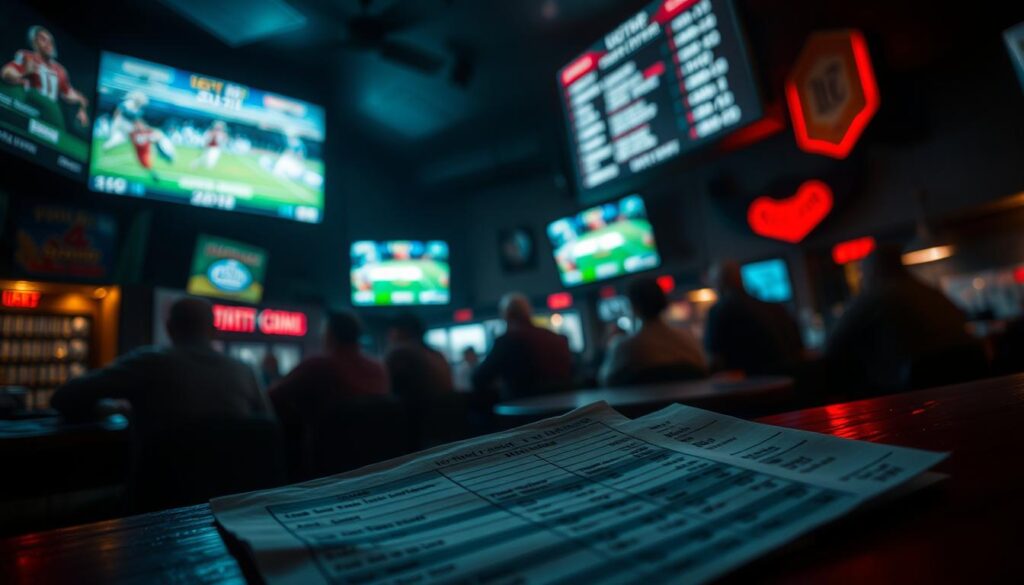
Sports betting slips are like ancient texts – one wrong symbol and you’re lost. It’s like trying to follow IKEA instructions backward. We’ll learn to read them fast, like Robert Langdon escaping the Vatican.
Every slip is like abstract art, full of creases and stains. Sportsbooks warn you about illegible slips, like a “you break it, you bought it” rule. A $2,500 win was lost because of a coffee stain. Barista art doesn’t count as proof.
Three key things make slips useful:
- Market Type: Knowing if it’s a spread, moneyline, or total is key. Getting it wrong can lead to confusion.
- Legibility: If your handwriting is hard to read, go digital.
- Expiration Dates: These are as binding as a handshake deal in Times Square.
Yahoo shows us how sportsbooks handle unclear slips. It’s like Amazon’s return policy – possible but slow. The process of getting a refund is like a mix of customer service and improv.
| Slip Element | Hidden Meaning | Common Sports Betting Mistakes |
|---|---|---|
| Stake Amount | Your financial commitment | Misplaced decimals ($10 vs $100) |
| Odds Format | Profit calculation key | American vs Decimal confusion |
| Event Date | Validity timeline | Betting closed games |
Pro tip: Take a photo of your slip like it’s the Mona Lisa. Digital backups are safer than Swiss bank vaults. Remember, the difference between winning and losing often comes down to one misplaced zero or smudged ink.
Common Betting Myths Debunked
Let’s clear up some myths: Sports betting myths spread fast, like UFO stories. People believe in “guaranteed win” strategies and horoscopes predicting Taylor Swift’s breakups. It’s time to use logic to debunk these myths.
Myth 1: “Hot Streaks Are Real”
The “hot hand” fallacy is a common betting mistake. Everyone believes in it at first, but reality sets in soon. Patrick Mahomes’ success doesn’t mean he’s invincible. Streaks are just random, not destiny.
Remember the 2004 Red Sox? Their comeback against the Yankees wasn’t magic. It was just variance working in their favor after 86 years.
Myth 2: “This Bet Is a Lock!”
Anyone claiming a “sure thing” bet is a red flag. Real locks are found in prisons, hair salons, and HBO dramas. Even LeBron has bad games. The last “can’t lose” bet I saw was a 20-point favorite losing to a team with a third-string quarterback.
Myth 3: Systems Beat Randomness
Forget about lucky charms and numerology. Sports are unpredictable, like Forrest Gump’s box of chocolates. I once followed a guy betting based on his cat’s sneezes. His win rate was the same as Wall Street analysts using AI.
The math doesn’t care about your lucky jersey or astrological alignment. Variance is the real MVP, affecting both teams.
Here’s the truth casinos don’t want you to know: Sportsbooks profit because humans see patterns in chaos. Your brain is wired to see patterns, like dinosaurs in clouds. Beat the house by recognizing randomness, not chasing ghosts.
Bankroll Tips for Beginners
Think of your bankroll as financial sourdough – it needs constant feeding and protection from moldy decisions. Just like you wouldn’t dump your entire kombucha SCOBY into a single brew, smart bettors never risk more than 1-5% per wager. But how does that translate to actual strategy?
Let’s break it down like a Spotify algorithm:
- 1% bets: Your background playlist – low-risk positions that keep the vibe alive
- 3% bets: The curated mixtape – strategic plays with calculated upside
- 5% bets: Front-row concert tickets – reserved for rare, high-conviction opportunities
Most beginners make the Enron mistake – chasing big scores like it’s 1999 dot-com stock. Savvy players? They’re the index fund investors of sports betting. I once watched a friend blow his entire roll on a -400 favorite because “it couldn’t lose.” Spoiler: It did. The final score haunts me more than my AIM chat logs from 2004.
Here’s where Marie Kondo enters the chat. Organize your betting slips like you’re tidying a closet:
- Track every wager in a spreadsheet (yes, even that 2am parlay)
- Label bets as “sparks joy” (value plays) vs “clutter” (impulse bets)
- Purge losing strategies faster than you’d delete cringe Myspace photos
Remember: Bankroll management isn’t about getting rich quick. It’s about staying in the game longer than a Netflix series reboot. The house edge is real, but so is compound growth – that $50/week disciplined approach could grow faster than your 401(k) during a bull market.
FAQs
Let’s channel our inner Office Space meme: “Yeahhhh… I’m gonna need you to keep that day job.” Sports betting can be exciting, but it’s not a reliable career. Vegas data shows 95% of recreational bettors lose in the long run. And that’s before dealing with the paperwork.
“Are sportsbook bonuses actually worth it?”
In your best infomercial voice: “But wait! There’s 25x rollover requirements!” Sign-up offers seem great, but they often require you to bet the bonus amount 25-40 times before you can cash out. It’s like getting “free” guac that costs $8 extra – it’s technically free, but it feels expensive.
“Explain odds conversion like I’m 5”
Imagine three cookie jars:
- American odds (+200): Bet $1 cookie → Get $2 profit + your cookie back
- Decimal odds (3.00): Total return = $3 per $1 cookie
- Fractional (2/1): Profit = $2 per $1 cookie
Now go clean your room.
“Is Vegas better than online betting?”
It depends. Do you prefer:
- ✅ $15 airport cocktails
- ✅ Cigar smoke embedded in your clothes
- ✅ The thrill of physically handing cash to a stranger
Our third source’s Vegas trip ended with a $300 blackjack loss and a memorable buffet experience. Choose wisely.
“Should I follow crypto bro betting tips?”
Ah yes, trust the guys who think “DYOR” means retweeting Elon memes. Their Lambo fantasies are great for fan fiction, but real bankroll management is different. It involves:
- Research beyond TikTok clips
- Track every bet
- Ignore DMs about “guaranteed systems”
Pro tip: If their strategy requires a VPN and 3 Red Bulls, maybe swipe left.
Conclusion
Learning about sports betting is like Mr. Miyagi’s “wax on, wax off” training. It’s not about quick wins but building skills over time. We’ve covered spreads, moneyline bets, and bankroll strategies to help you bet wisely.
Success in sports betting comes from careful planning, not impulsive decisions. Think like a chess master studying Sicilian defenses. This way, you’ll make smart bets, not reckless ones.
Remember, the goal is to enjoy betting, not to chase losses. DraftKings and FanDuel are tools, not casinos. Yoda’s wisdom helps: “Bankroll management leads to enjoyment. Chasing losses leads to dark side credit card statements.”
Responsible gambling means setting limits and knowing when to stop. Whether betting on NFL or Premier League, the real victory is in knowing when to walk away. The Wolf of Wall Street crew never understood this.
Now you know the basics of sports betting. The question is, will you be a careful strategist or a reckless trader? The smart choice is to be methodical, not impulsive. Every underdog story starts with caution.
Leave a Reply