
Have you ever looked at betting odds and wondered what they truly mean? Those numbers represent more than just potential payouts. They hold a hidden calculation called implied probability.
This concept is the conversion of odds into a simple percentage. It shows the event’s estimated likelihood of happening, according to the sportsbook’s math. It’s the foundation of informed wagering.
For bettors moving from casual fun to serious strategy, grasping this is crucial. It helps you assess if a bet offers real value. This is the first step toward smarter decisions.
Remember, this percentage is not a guarantee. Upsets happen in every sport. It’s simply the bookmaker’s estimation of the chance a team will win.
This guide will walk you through the basics. You’ll learn how to calculate this figure from different odds formats. We’ll explain why the total across all outcomes exceeds 100%—the house edge.
We’ll use real examples from the NFL and major events. By the end, you’ll translate confusing numbers into clear percentages. This knowledge will sharpen your approach to the market.
Understanding Implied Probability: The Foundation of Smart Betting
Think of implied probability as the hidden language of betting odds, revealing the bookmaker’s estimated likelihood. It transforms confusing numbers into a clear percentage. This figure is the core math behind every line you see.
Mastering this concept separates casual players from strategic bettors. It allows you to see the market’s true opinion. You can then compare it to your own analysis.
What Implied Probability Represents
This percentage shows the estimated chance of a specific outcome occurring. It is derived directly from the posted odds. The sportsbook calculates this, not the bettor.
It is crucial to distinguish this from “true odds.” True odds reflect the actual chances of an event. Your own assessment as a bettor is your perceived probability outcome.
The gap between these figures is where value is found. If your assessed chance is higher than the book’s implied figure, you may have a good bet. This is the fundamental search for value in sports wagering.
For example, consider a moneyline market for the San Francisco 49ers (-180) versus the Denver Broncos (+150). The conversion gives us clear percentages.
| Team | Moneyline Odds | Implied Probability |
|---|---|---|
| San Francisco 49ers | -180 | 64.2% |
| Denver Broncos | +150 | 40.0% |
These numbers help answer a key question. Does my team have a greater chance of winning than what these odds imply? The table provides a standardized view beyond plus/minus numbers.
How Sportsbooks Use Implied Probability
Bookmakers use this calculation as their primary pricing tool. Sophisticated models predict outcomes and set lines accordingly. The implied probabilities are the engine behind every price.
Critically, sportsbooks build their profit directly into these percentages. The displayed figure represents more than pure true chances. It includes a built-in margin, known as the vig or juice.
This means the total across all possible outcomes will always exceed 100%. The extra portion is the house’s guaranteed profit. For the bettor, recognizing this built-in edge is vital.
Understanding this representation allows for objective comparison. You can gauge how lopsided a matchup is. You can see if the market view aligns with your research.
Grasping what implied probability represents is the essential first step. It lets you deconstruct any betting line. This knowledge moves you toward smarter, more informed wagers.
The numbers on a sportsbook screen aren’t just prices; they’re a math problem waiting to be solved. Learning to solve it is your key to smarter wagering.
This section provides the exact formulas you need. You will learn to convert any odds format into a clear percentage. This skill turns raw numbers into actionable insight.
How to Calculate Implied Probability from Betting Odds
The process is straightforward but fundamental. Different regions use different odds formats. The two most common are Decimal and American (Moneyline).
You must know how to handle both. Each has a specific formula for conversion. Let’s break them down step by step.
Step 1: Converting Decimal Odds to Implied Probability
Decimal odds are popular in Europe, Canada, and for total payout displays. The calculate implied probability formula is universal and simple.
You take the number one and divide it by the decimal odds. Then, multiply the result by 100 to get a percentage.
Formula: Implied Probability = (1 / Decimal Odds) * 100%
For example, odds of 2.50 imply a (1 / 2.50) * 100 = 40% chance winning. Odds of 1.50 imply a (1 / 1.50) * 100 = 66.7% chance.
Step 2: Converting American Odds to Implied Probability
American or Moneyline odds use positive and negative numbers. The calculation differs for favorites (-) and underdogs (+).
For negative American odds (e.g., -180): Use the absolute value. The formula is Odds / (Odds + 100) * 100%.
For positive American odds (e.g., +150): The formula is 100 / (Odds + 100) * 100%.
Let’s apply this to a real NFL matchup. We’ll calculate the odds implied chance for each team.
| Team | Moneyline Odds | Calculation | Implied Probability |
|---|---|---|---|
| San Francisco 49ers (Favorite) | -180 | (180 / (180 + 100)) * 100 | 64.2% |
| Denver Broncos (Underdog) | +150 | (100 / (150 + 100)) * 100 | 40.0% |
This table shows the direct math. The favorite’s probability is over 60%. The underdog’s is exactly 40%. Notice the total is 104.2%, not 100%. We’ll explain that next.
Using Implied Probability Calculators for Efficiency
Doing this math manually is great for learning. For speed, especially with multiple bets, online tools are invaluable.
An implied probability calculator does the work instantly. You input the betting odds, and it outputs the percentage.
This efficiency is crucial when analyzing complex markets or futures. It lets you focus on comparing odds and finding value, not on arithmetic.
Practice these conversions until they feel natural. They are the essential tool for all advanced analysis. Your next step is to see what happens when you add up all outcomes in a market.
The House Edge: Demystifying Vigorish and Overround
To consistently profit, bettors must first understand the unavoidable tax applied to every wager. This built-in cost is the house edge, and it manifests through two key concepts: the vig and the overround.
Mastering these terms reveals how sportsbooks guarantee their profit. It also shows what you’re truly up against in the market.
What Is the Vig (Juice) in Sports Betting?
The vig, or juice, is the sportsbook’s commission. It’s embedded directly into the betting odds you see. This margin ensures the book makes money over time.
Consider a standard NFL point spread. Both sides are often listed at -110. Using the implied probability formula, each side has a 52.4% probability.
Add them together: 52.4% + 52.4% = 104.8%. The extra 4.8% is the vig. This represents the book’s theoretical hold on that market.
Here’s the practical impact. If you bet $110 on each side of that spread, you risk $220.
You would win $210 back (your $110 stake plus $100 profit on the winning side). This guarantees a $10 loss. That $10 is 4.8% of your total $220 risked.
This simple math shows the vig in action. It’s a direct cost for the bettor.
How Overround Ensures Sportsbook Profit
The total implied probability of all outcomes in a market is called the overround. When this sum exceeds 100%, the surplus is the house edge.
This principle applies to all bet types, not just spreads. Look at this moneyline example.
| Market Type | Side / Team | Odds | Implied Probability | Total Overround |
|---|---|---|---|---|
| NFL Spread | Side A | -110 | 52.4% | 104.8% |
| NFL Spread | Side B | -110 | 52.4% | |
| Moneyline | Denver Broncos | -190 | 65.5% | 104.0% |
| Moneyline | Oakland Raiders | +160 | 38.5% |
The overround is the sportsbook’s “cushion.” It ensures they turn a profit regardless of the outcome, so long as bets are balanced.
The size of this cushion varies. Major sports like the NFL typically have a 4-5% house edge.
Futures markets can have lower margins. A World Cup winner market might show an overround of just 2.6%.
Recognizing this edge is not about beating it on a single bet. It’s a constant cost of doing business.
Your long-term success depends on finding value that exceeds this built-in margin. Developing strong odds literacy is the first step to managing this cost effectively.
The percentage you calculate tells the real story. Always check if the total probability adds up to more than 100%.
That extra amount is the price you pay to play. Smart bettors account for it in every decision they make.
Why Implied Probabilities Always Exceed 100%
A fundamental rule of sports betting math is that the sum of implied probabilities exceeds 100%. This isn’t a mistake. It’s the definitive evidence of the sportsbook’s built-in margin.
This surplus is called the overround or vig. It’s how books guarantee their profit over the long run. For bettors, recognizing this is key to managing expectations.
The Mathematical Proof: Adding Up Probabilities
The proof is straightforward. Take a standard point spread market with odds of -110 on each side.
Using the conversion formula, each side has an implied probability of 52.4%. Add them together: 52.4% + 52.4% = 104.8%.
This total, over 100%, is the overround. In a fair market with no margin, the odds would reflect the true 100% chance.
For a coin flip, fair odds would be +100 for each outcome. The calculation would be (100 / (100+100)) * 100 = 50% per side.
| Market Type | Odds per Side | Implied Probability per Side | Total Probability |
|---|---|---|---|
| Fair Market (No Vig) | +100 | 50.0% | 100.0% |
| Standard Sportsbook | -110 | 52.4% | 104.8% |
The table shows the direct impact of the vig. The book’s prices add an extra 4.8% to the total.
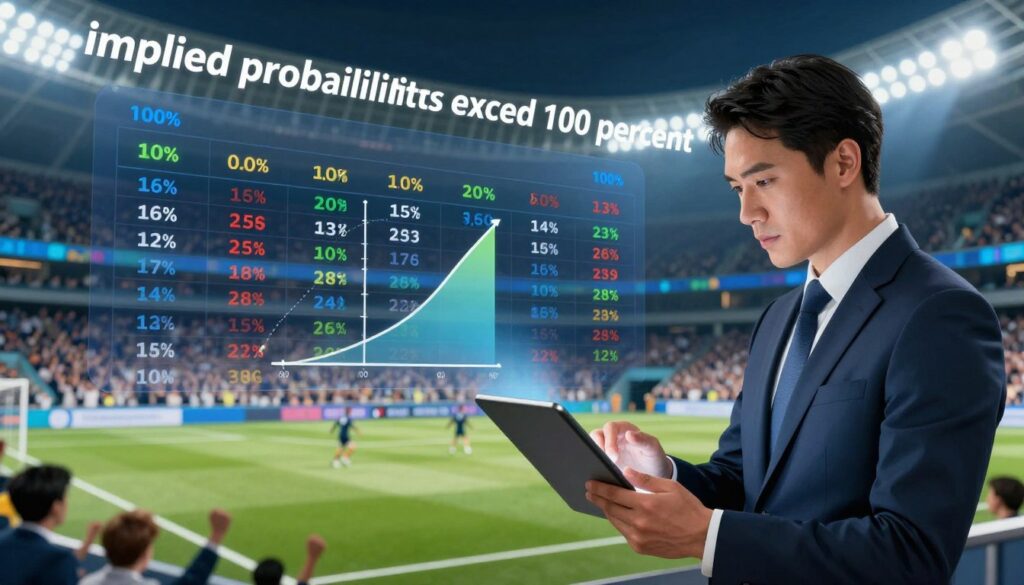
This design is intentional. It ensures the house wins if bets are balanced across both possible outcomes.
Real-World Impact on Bettor Returns
This mathematical rule has a direct cost. Even if you correctly handicap a 50/50 event, you are paid at odds that imply a less than 50% chance.
To break even at -110 odds, you must win more than 52.4% of your wagers. This is the hurdle rate created by the overround.
Consider this analogy. Betting on both sides of a two possible outcomes market with a 104% total means risking $104 to win back $100.
- You bet $52 on Side A at -110.
- You bet $52 on Side B at -110.
- Total risk: $104.
- The winning bet returns $100 (stake + profit).
- Net result: A locked-in $4 loss.
This $4 represents the 4% house edge. It’s the price of participating in the betting market.
Therefore, long-term success isn’t about picking winners. It’s about finding value.
You must identify situations where your assessed percentage is higher than the book’s implied figure. The difference must be large enough to overcome this built-in margin.
Understanding the “why” behind probabilities exceeding 100% frames the entire challenge. Profitable bettors seek inefficiencies in the sportsbook’s model.
They look for spots where the true chance of an outcome is greater than what the odds suggest.
Implied Probability in Action: Practical Examples
Practical examples bridge the gap between abstract formulas and actionable betting insights. Let’s apply the math to real scenarios. This will solidify your grasp of the concept.
We’ll start with a simple coin toss. Then, we’ll move to NFL games. Finally, we’ll examine a complex futures market.
Simple Coin Flip Scenario with Even and Uneven Payouts
Consider a fair coin flip. There are two possible outcomes: heads or tails. Each has a true 50% chance.
At fair odds of +100 (even money), the implied probability is 50% for each side. You risk $100 to win a total payout of $200.
Now, imagine uneven payouts. What if heads pays $100 profit, but tails pays $200?
The calculation changes. For heads, the implied probability is $100/$300 = 33.3%. For tails, it’s $200/$300 = 66.7%.
The sum is still 100%. But if the true chances are 50/50, one side holds a big edge. Betting on heads here would be a poor bet.
Moneyline and Spread Betting in NFL Games
Now, let’s use a real sports example. Recall the San Francisco 49ers (-180) versus the Denver Broncos (+150).
We calculate the implied chance for each team. For the 49ers: (180 / (180+100)) * 100 = 64.2%. For the Broncos: (100 / (150+100)) * 100 = 40.0%.
The bookmaker sees the 49ers as a strong favorite. The total of these figures is 104.2%, showing the vig.
Point spread bets work similarly. A spread of Denver -3.5 (-110) vs. Oakland +3.5 (-110) is common.
Each side at -110 has an implied chance of 52.4%. Add them together: 52.4% + 52.4% = 104.8%.
This overround is the sportsbook’s built-in profit margin. You must win more than 52.4% of such bets to profit.
Futures Markets: Calculating Probabilities for the World Cup
Futures markets have many outcomes. Let’s examine a World Cup winner market.
Here are the odds and their calculated implied chances:
| Team / Selection | American Odds | Implied Probability |
|---|---|---|
| Brazil | +400 | 20.0% |
| Germany | +800 | ~11.1% |
| Argentina | +900 | 10.0% |
| Italy | +1050 | ~8.7% |
| USA | +3500 | ~2.8% |
| Field | +100 | 50.0% |
Adding these percentages yields roughly 102.6%. This reveals a house edge of only about 2.6% for this futures event.
The “Field” bet is a catch-all for any team not listed. Its high 50% implied chance reflects the depth of competition.
This example shows how books price multi-way markets. The total implied chance always exceeds 100%.
These examples, from a coin to the World Cup, demonstrate the universal utility of this calculation. It is the key to interpreting any set of odds.
By converting prices to percentages, you can compare chances across different markets. This skill is foundational for finding value, a topic explored in depth in our guide on understanding implied probability and edge.
Using Implied Probability to Find Value Bets and Calculate Edge
The pursuit of long-term profit in sports betting hinges on one core skill: calculating your edge. This section moves from theory to action. It shows how to use the implied probability you’ve learned to spot profitable value bets.
Comparing Your Assessed Probability to the Implied Probability
A value bet exists when your personal assessment of an outcome‘s chance exceeds the book’s implied figure. This gap is the foundation of value betting.
Forming your assessed probability requires research. You analyze stats, injuries, trends, and motivation. This creates your “true odds” for the event.
Contrast this with the sportsbook’s implied probability sports calculation. Their number includes the vig and market sentiment. Your goal is to find where your analysis is more accurate.
This comparison is the first step. You must be honest and disciplined in your evaluation. The market is often efficient, but not always perfect.
The Formula for Calculating Your Betting Edge
Once you have both percentages, calculate your edge. The core formula is simple yet powerful.
Edge = (Your Assessed Probability – Implied Probability) * 100%
Consider this example. You believe a team has a 60% likelihood to win. The odds imply only a 50% chance.
Your edge is (60% – 50%) * 100 = 10%. This positive edge suggests a theoretically profitable bet over time.
A negative result means the odds are too short. The sportsbook’s probability sports betting math overvalues the outcome. You should avoid these wagers.
This edge represents your expected advantage per wager. It systematically overcomes the house’s vig. Consistently finding positive edge is the only path to sustained profit.
Identifying Value in Underdogs and Favorites
Value can hide in any market, on any team. Let’s examine both sides.
For an underdog, the odds implied probability might be 40% (+150). Your research suggests they have a 45% true chance.
Your edge is 5%. This makes the +150 bet a value play. The odds are longer than they should be.
Favorites can also offer value. Imagine a favorite with an implied probability sports of 70% (-233). You assess their true chance at 75%.
Here, the -233 odds now represent value. Your edge is 5%. As a source notes, “You might think that the 49ers are good value at -180 because your true odds… put it more toward 70% (-233).”
This logic applies across all possible outcomes. It requires comparing percentages, not just gut feelings.
Consistent value betting demands discipline. A winning bet can lack value if the odds were too low. A losing bet can have had value if the chances were underestimated.
Incorporate this into your routine. Calculate implied figures for every line you consider. Compare them to your own numbers. This methodical approach is key for serious bettors.
Mastering this skill transforms how you view probability sports wagering. It turns random bets into calculated investments. For more on applying this to different wagers, see our guide on exploring sports bet types with real-life.
Advanced Strategies: Incorporating Implied Probability into Your Betting Approach
Moving beyond single bets, advanced strategies use implied probability to categorize games, manage risk, and optimize bankroll allocation. This transforms raw math into a structured framework for consistent decision-making.
It’s about applying the percentage you calculate across your entire slate. This systematic approach separates recreational play from a professional mindset.
Categorizing Games by Implied Probability Tiers
A powerful first step is to tier all games on a slate, like an NFL Sunday, based on their implied probability. This creates a clear risk profile for your betting card.
Common tiers break down as follows:
| Tier Name | Implied Probability Range | Example American Odds | Risk Profile |
|---|---|---|---|
| Heavy Favorite | > 66% | -200 or shorter | Lower Volatility |
| Moderate Favorite | ~60% | -150 | Moderate Risk |
| Narrow Favorite | 54% – 60% | -125 to -110 | Higher Risk |
| Close Call / Underdog | +110 or longer | Highest Risk, Highest Reward |
This categorization directly informs your betting aggression. Conservative bettors may focus on Heavy Favorites for more predictable, lower-volatility outcomes.
Aggressive bettors often hunt for value in the Narrow Favorite and Underdog tiers. These games present larger potential payouts but come with greater uncertainty.
Your personal risk tolerance should guide which tiers you target most frequently.
Adjusting for Market Inefficiencies and News
Odds are not static. Line movement is a critical data point. A shift from -150 to -130 means the market‘s implied probability for that team has decreased.
This movement can be driven by public betting or “sharp” money. Recognizing the difference is key. Sharp action often indicates informed opinion against the public sentiment.
Late-breaking news is another crucial factor. A key injury or severe weather forecast can drastically change an event‘s true chances.
- Update Your Assessment: Immediately revise your personal probability estimate.
- Compare to the Line: See if the sportsbook’s odds have fully adjusted. There’s often a lag.
- Identify Value: This gap can reveal last-minute value bets before the market corrects itself.
Staying agile and informed turns market noise into opportunity.
Long-Term Bankroll Management Based on Probability
The final pillar connects your calculated edge directly to the amount you wager. This is where profit is sustained or lost over time.
Your stake should reflect the strength of your conviction. Methods like the Kelly Criterion use your edge and the odds to suggest an optimal bet size.
A simpler approach is flat-betting a fixed percentage of your bankroll, adjusting slightly for confidence.
Core Principle: Bets with a larger positive edge warrant a larger stake. Smaller edges or speculative plays should use much smaller stakes.
This disciplined approach ensures you survive inevitable downswings. Variance will cause short-term swings, even with a solid edge.
Proper bankroll management, informed by probability analysis, keeps you in the game. It allows your long-term edge to overcome random luck. For a deeper dive into building your own probability models, explore this resource on data-driven probability models.
Integrating implied probability into game categorization, line analysis, and stake sizing transforms sports wagering. It evolves from a reactive hobby into a proactive, analytical process built for long-term success.
Conclusion: Elevating Your Betting with Implied Probability
The true power of odds lies not in the payout, but in the percentage they hide. This calculation is your core skill for smarter sports betting.
You can now translate any betting odds into a clear number. You also see the house edge when the total exceeds 100%. This insight is critical for all bettors.
Use this figure as a benchmark. Compare it to your own researched chance. This is how you spot value bets and calculate your edge.
Mastering implied probability doesn’t guarantee single wins. It systematically elevates your game from guesswork to informed analysis. Keep practicing this skill. It is the foundation for sustainable success in the markets.
Leave a Reply