

The landscape of wagering in the United States has changed dramatically. With the rise of online platforms, fans can now engage from anywhere. This ease of access has welcomed a huge wave of new participants.
Before you risk your money, it’s crucial to grasp the fundamentals. This guide is your starting point. We’ll walk you through the core concepts every newcomer should know.
You will learn common terms like odds and how different wagers work. We explain the simple steps to place your first bet. Our goal is to build your confidence with clear, practical knowledge.
Understanding this activity isn’t just about picking winners. It’s about a smart and responsible strategy from day one. We’ll touch on legal points and managing your bankroll.
For a deeper dive into point spreads and moneylines, check out this beginner’s guide to sports betting. Let’s begin your informed journey into this exciting world.
Introduction: Your First Step into the World of Sports Betting
Stepping into the world of wagering on athletic contests is a thrilling adventure that begins with a solid foundation. It might look complex with all its numbers and terms.
This guide is here to change that. We will break everything down into simple, manageable pieces.
You’ll first learn about the sportsbook. This is the platform where all the action happens. Think of odds as the universal language of risk and reward.
They translate probability into a clear number you can understand. A core rule you must embrace is bankroll management.
This is the practice of only risking money you can afford to lose. It’s the cornerstone of playing smart and staying in control.
We will explore the different types of wagers available. You can predict a straight game outcome, the margin of victory, or the total score.
Markets also include long-term events and specific player performances. Practical knowledge is key.
We’ll show you how to use promo offers to boost your starting cash. You’ll also learn how to navigate the legal landscape in your state.
Most importantly, responsible participation will be a constant theme. This ensures your experience remains positive.
Here’s what your learning journey will cover:
- Understanding what a sportsbook is and how it works.
- Decoding odds and what they mean for your potential profit.
- Mastering bankroll management to protect your funds.
- Exploring popular wager types, from moneylines to prop bets.
- Using promotions and bonuses to your advantage.
- Knowing the legal framework for wagering in the U.S.
- Committing to responsible play from your very first bet.
By the end, you’ll have the confidence to place your first informed bet. Let’s build your knowledge step by step.
What Are Sports Betting Basics? Understanding the Core Idea
At its heart, wagering on athletic events is a simple concept of prediction and risk. The fundamentals are the essential rules and mechanics that make this activity possible. Think of them as the framework for every decision you will make.
This core idea involves forecasting the outcome of a match or event. You then stake money on that forecast through a licensed platform. If your prediction is correct, you earn a profit.
Two pillars support this entire system. The first is the platform where wagers are made. The second is the act of committing your funds to a pick.
Grasping these basics is your first real step. They provide the context for understanding odds, spreads, and all other market types. Let’s break down each pillar.
The Role of the Sportsbook
A sportsbook is the marketplace for all wagers. It is the company that accepts and pays out bets. This platform sets the odds and creates markets for thousands of games.
Its primary function is to facilitate action between participants. The sportsbook acts as your counterparty for every bet. It uses expert oddsmakers and complex algorithms to balance risk.
This balancing act creates a fair and engaging market. The business model includes a built-in fee called the vigorish or “vig”. This ensures the house maintains a slight edge over time.
Without a licensed sportsbook, there is no secure way to place bets. It is the essential engine of the entire ecosystem. Understanding its role helps you see how prices are set.
What Does “Placing a Bet” Actually Mean?
This phrase describes the specific actions you take to risk your cash. It is a straightforward process with four clear steps.
First, you select the sporting event you want to focus on. This could be a football game between two teams or a tennis match.
Next, you choose the type of wager you wish to make. Common types include picking the winner or predicting the total score.
Then, you decide on your stake. This is the amount of money you are willing to risk on your pick.
Finally, you confirm the bet on the sportsbook platform. Your funds are deducted, and a ticket is created.
If you win, your payout includes your original stake plus profit. The profit is determined by the odds attached to your selection. These odds represent the price of your wager.
Mastering this simple process is crucial. It frames every single decision you will make as a participant. Now you’re ready to explore specific bet types with confidence.
How Sports Betting Odds Work: Reading the Numbers
To make informed decisions, you must first learn to interpret the numbers presented by the sportsbook. These figures are not random. They are a precise language that communicates risk, reward, and probability.
Understanding this numerical code is essential for calculating your potential payout. It also helps you assess the implied likelihood of any event. This knowledge forms the bedrock of every smart wager you will place.
We will focus on the American odds format, the standard system across the United States. It is characterized by the plus (+) and minus (-) symbols you see next to every team or player.
American Odds: The + and – System
The American odds system uses a simple visual rule. The minus sign (-) always denotes the favorite in a matchup. The plus sign (+) always represents the underdog.
This foundational rule helps you instantly gauge which side the sportsbook believes is more likely to win. The number following the sign tells you the exact financial terms of the wager. It dictates how much you need to risk or how much you can win.
Remember, these odds are not just about who will win. They reflect the market’s consensus and the book’s built-in margin. Learning to read them is your first step toward finding value.
What Plus Odds (+) Tell You
Plus odds indicate the underdog. They show you the profit you would earn on a $100 stake. A higher plus number means a larger potential return.
For example, if a team is listed at +200, a successful $100 wager yields a $200 profit. Your total return would be $300 ($100 stake + $200 profit).
These numbers signal a less probable outcome in the eyes of the oddsmakers. The bigger the underdog, the higher the plus figure. This offers a greater reward for taking on that increased risk.
What Minus Odds (-) Tell You
Minus odds represent the favorite. They tell you how much money you need to risk to win a $100 profit. A larger minus number means you must bet more to gain that $100.
For instance, a team at -150 requires a $150 wager to earn a $100 profit. Your total return would be $250 ($150 stake + $100 profit).
This format shows a more likely outcome. The sportsbook requires a larger commitment for a smaller guaranteed return. It’s the price you pay for backing the expected winner.
| Odds Type | Sign | What It Represents | Example | To Win $100 Profit | Total Payout on $100 Bet |
|---|---|---|---|---|---|
| Plus Odds | + | Underdog / Less Likely Outcome | +250 | Bet $100 | $350 ($100 + $250 profit) |
| Minus Odds | – | Favorite / More Likely Outcome | -180 | Bet $180 | $280 ($180 + $100 profit) |
| Plus Odds | + | Major Underdog | +450 | Bet $100 | $550 ($100 + $450 profit) |
| Minus Odds | – | Strong Favorite | -300 | Bet $300 | $400 ($300 + $100 profit) |
This table provides a clear comparison for quick reference. Use it to translate the numbers you see into real-world dollar amounts.
Understanding these calculations allows you to gauge implied probability. You can also compare prices across different platforms. This skill is critical for identifying the best value for your cash.
Always check the odds before you confirm any wager. A slight difference in the number can significantly impact your potential profit. Now you have the key to reading the most important numbers in the game.
Bankroll Management: The Foundation of Smart Betting
The most critical skill for any new participant isn’t about picking winners. It’s about protecting your funds.
This financial discipline is what separates casual play from costly mistakes. It’s the non-negotiable framework for a sustainable experience.
Your bankroll is the total amount of money you set aside for this activity. This cash must be separate from your essential living expenses.
Think of it as your entertainment budget. You should be comfortable with the idea of potentially losing all of it.
The core principle is to risk only a small, fixed percentage on any single bet. Most experts recommend between 1% and 5% of your total bankroll.
This strategy allows you to withstand normal losing streaks. It prevents one bad day from wiping out your entire fund.
The goal here is long-term engagement, not a get-rich-quick scheme. Proper management shields you from emotional decision-making.
It keeps the focus on smart, calculated wagers over impulsive reactions.
A major danger is the urge to “chase losses.” This happens after a few unsuccessful bets.
The participant increases their stake size to win back what was lost quickly. This emotional spiral is a primary cause of significant financial trouble.
Sound bankroll management actively fights this impulse. It provides a clear rulebook for your play.
Here are practical strategies to implement immediately:
- Keep a Log: Record every wager, including the odds, stake, and outcome. This creates accountability and reveals your true performance.
- Set Hard Limits: Decide on strict daily, weekly, or monthly loss limits in advance. Once you hit that limit, you stop for that period.
- Use Unit Sizing: Define one “unit” as your fixed percentage (e.g., 2%). Every bet you place should be for 1 unit, keeping your risk consistent.
- Review Regularly: Assess your bankroll total weekly. Adjust your unit size only based on your current total, not your emotions.
Without this foundation, even the most insightful betting picks lead nowhere. A participant’s journey will likely be short-lived.
Mastering your money is the first and most important step. It ensures your foray into sports remains a fun and controlled form of entertainment.
The Three Most Common Types of Sports Bets
The vast array of options can be simplified into three core categories every newcomer should know. These foundational wagers form the backbone of most markets you will encounter.
Mastering them allows you to engage with any game or event confidently. Each type offers a different way to predict the outcome.
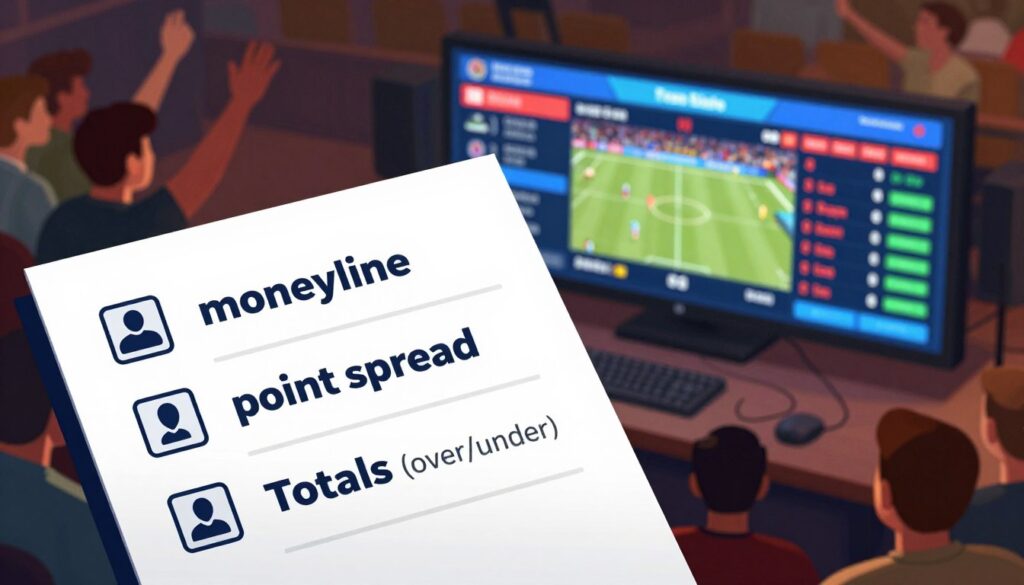
Moneyline Bets: Simply Picking the Winner
This is the most straightforward type of wager. You are picking which team or player will win the game outright.
The odds determine your potential payout. A favorite has negative odds, while an underdog has positive ones.
For example, the Warriors might be listed at -150. This means you must risk $150 to win a $100 profit.
The opposing Rockets could be at +130. A successful $100 bet here returns a $130 profit.
Your total payout includes your original stake. Moneyline bets are perfect for when you strongly believe in one side’s ability to win.
Point Spread Bets: Betting on the Margin of Victory
This wager levels the playing field by using a handicap. You are betting on the margin of victory, not just the winner.
The favorite must win by more than the spread. The underdog must lose by less than the spread or win outright.
You will see lines like Chiefs -6.5 or Jets +6.5. If you bet on the Chiefs, they must win by a touchdown (7 points) or more.
A bet on the Jets wins if they lose by 6 or fewer points, or if they win the game. The point spread creates action on both sides of a matchup.
It turns a lopsided contest into an engaging bet.
Totals (Over/Under) Bets: Predicting the Combined Score
Also called Over/Under bets, this type focuses on the combined final score of both teams.
The sportsbook sets a number representing the predicted total points. You bet whether the actual total score will be Over or Under that line.
For a football game, the line might be set at 48.5 points. If you think both offenses will perform well, you take the Over.
You win if the combined score is 49 or higher. Factors like team defense and weather can influence this number.
It’s a great wager when you have a feel for the pace of a game, not just who wins.
These three formats are your essential toolkit. For a deeper look at how they work in real scenarios, consider exploring more bet types with real-life.
Exploring Other Popular Ways to Wager
The next level of engagement involves markets focused on long-term outcomes, specific in-game moments, and combined picks. Beyond the foundational wagers, numerous other types exist.
They allow for more specialized and potentially lucrative opportunities. Understanding each type‘s unique rules and risks is key.
This knowledge lets you diversify your approach effectively. You can tailor your activity to your interests and insights.
We will explore three major categories: futures, props, and parlays. Each offers a distinct way to interact with the games you love.
Futures Bets: Long-Term Predictions
Futures bets are wagers on outcomes that will be decided far in the future. Common examples include league champions, MVP awards, or division winners.
You might bet on a team to win the Super Bowl in August. The appeal lies in the higher odds available early in a season.
A 50-1 World Series future could yield a massive profit. Your cash is tied up for the entire campaign, however.
This is the primary risk. Injuries, trades, or slumps can impact the outcome months later.
Your money remains locked until the event concludes. Futures constitute a notable portion of common mistakes.
Some analysts find value in markets like golf futures. Odds can shift dramatically based on early tournament play.
For a comprehensive look at all types, consider exploring more bet types with detailed examples.
Prop Bets: Wagering on Specific Events Within a Game
Prop bets (proposition bets) focus on specific occurrences within a single game. They may not relate directly to the final score.
You can bet on a player‘s performance, like rushing yards or three-pointers made. Other props involve novel events, such as the color of a Gatorade bath.
These wagers add incredible depth to your game engagement. They require knowledge of individual matchups and trends.
NFL player props are hugely popular during prime-time games. Last season, a significant percentage of participants wagered on a quarterback’s rushing yardage.
Factors like weather or coaching comments can directly affect prop outcomes. A windy day might lower a pitcher’s strikeout number.
Mastering prop bets means looking beyond the point spread. It’s about predicting the micro-events that define a contest.
Parlay Bets: Combining Picks for a Bigger Payout
A parlay bet combines two or more individual selections into one ticket. All legs must win for the entire wager to pay out.
The odds multiply, leading to exponentially higher potential returns. This comes with an all-or-nothing risk profile.
For example, a five-team NFL parlay might turn a small stake into a large sum. One losing selection causes the entire bet to lose.
Constructing a smart parlay involves strategy. Many platforms now offer same-game parlays, combining multiple bets from one contest.
Another variant is the teaser, a parlay with adjusted point spreads. It requires a very high win rate to be profitable long-term.
The math behind these combined wagers is crucial to understand. The high reward is balanced by significantly increased risk.
Beginners should explore these markets only after mastering the basics. Always prioritize understanding the unique risk each type carries.
Using Sportsbook Promotions and Bonuses Wisely
One of the most immediate benefits for newcomers is access to a variety of sign-up incentives and ongoing deals. Platforms compete fiercely for customers, and their promotional offers are a major part of that battle.
Used strategically, these promos can provide real value and extend your playing time. However, they come with specific rules you must understand.
This section breaks down the two main categories: welcome bonuses for new users and ongoing promos for regulars. Learning to use them wisely is a key skill.
Welcome Bonuses for New Users
When you register at a new platform, you’ll often be greeted with a welcome offer. These are designed to reduce the initial risk as you place bets for the first time.
Common structures include “first bet insurance” or a deposit match. First bet insurance might refund your stake as site credit if your initial wager loses.
A deposit match could give you bonus cash equal to a percentage of your first deposit. This effectively boosts your starting bankroll.
The critical step is reading the terms and conditions. Look for the wagering requirement, which states how many times you must play through the bonus money before withdrawing.
Also, note expiration dates. Bonus bets often expire within seven days of being issued. You typically claim these offers by entering a promo code during sign-up or opting in within the app.
Ongoing Promotions for Existing Customers
After the welcome offer, platforms work to keep you engaged. Ongoing promos come in many types.
Profit boosts temporarily increase the odds on a specific market, raising your potential profit. Parlay insurance might refund your stake if one leg of a multi-pick bet fails.
Loyalty or rewards programs award points for your activity. These points can be exchanged for bonus cash, free bets, or other perks.
The golden rule here is simple: never let a bonus dictate a wager you wouldn’t otherwise make. A boosted odds promo on a longshot is still a risky pick.
These tools are best used to enhance your existing strategy, not replace it.
Smart use of promos can effectively increase your funds. Remember, they are marketing tools with conditions, not “free money.”
Beginners should compare offers across different legal sportsbooks as part of their research. A generous welcome promo with fair terms can be a great way to start.
Always prioritize the platform’s reputation and your own strategy over the flashiest bonus. This disciplined approach ensures you extract maximum value from every offer.
Is Sports Betting Legal? Understanding the U.S. Landscape
Before you consider any wager, the first question you must answer is a legal one.
The rules are not the same everywhere. In the United States, legality is determined by each individual state.
This state-by-state system began in 2018. That year, a federal law called PASPA was repealed.
The change allowed states to craft their own regulations. Today, the landscape is a complex patchwork.
Sports betting is legal in some form in forty states and Washington, D.C. This includes both retail locations and online platforms.
The most convenient method, online wagering, is currently live in thirty-four states.
These states range from Arizona and Colorado to New York and Virginia. Missouri launched its online market in December 2025.
It is crucial to verify the status in your specific location. Using an illegal, offshore book carries severe risks.
You could face penalties, non-payments, or data breaches. Licensed operators provide critical consumer protections.
The basic regulatory framework has several common pillars. All legal sportsbooks must be licensed by the state.
They enforce strict age verification. You must be 21 or older in most jurisdictions.
Geolocation technology ensures bets are placed only within state lines. This technology is a cornerstone of compliance.
Some states offer only retail betting at casinos or racetracks. A few states prohibit all forms of this activity.
California, Texas, and Utah are notable examples where it remains illegal.
Understanding this landscape protects you from fraudulent operators. It ensures your rights are safeguarded.
We strongly recommend using only a licensed, regulated sportsbook app or website. Always confirm the platform operates legally in your jurisdiction.
For a detailed, up-to-date look at the current legal landscape, including specific state details, further research is invaluable.
How to Start Betting: A Step-by-Step Guide for Beginners
You’ve learned the theory; now it’s time to put that knowledge into practice with your first real wager. This guide provides a clear, step-by-step path from being a spectator to an active participant.
We’ll translate everything you’ve read into direct action. Follow these four steps to make your initial pick with confidence.
1. Research and Choose a Legal Sportsbook
Your first task is finding a safe, licensed platform in your state. Use your state’s gaming commission website for an official list of operators.
Never use an offshore site. It lacks consumer protections and is illegal.
Compare a few top legal sportsbooks. Look at their app reviews, the competitiveness of their odds, and their promo offers for new users.
A good welcome bonus can boost your starting funds. Also, check which payment methods they accept.
The table below compares key features to consider during your research.
| Feature to Compare | Why It Matters | What to Look For |
|---|---|---|
| Licensing & Legality | Ensures your money and data are safe. Guarantees payouts. | Operator is listed on your state’s official gaming website. |
| User Interface | Affects how easily you can find games and place bets. | App has high ratings, is intuitive, and loads quickly. |
| Odds Quality | Directly impacts your potential profit on winning wagers. | Compare moneyline odds for the same game across multiple books. |
| Welcome Promotion | Adds extra value to your initial deposit or first bet. | Reasonable playthrough requirements and a fair bonus amount. |
| Deposit Options | Determines how you can add money to your account. | Multiple methods like credit/debit cards, PayPal, or bank transfer. |
2. Create Your Account and Claim a Promotion
Once you pick a platform, click “Sign Up.” You’ll need to provide some personal details for identity verification.
This step is mandatory for all legal operators. It confirms you are of legal age and located within state lines.
During registration, look for a field labeled “Promo Code” or “Offer Code.” Enter any valid code to activate the welcome bonus.
Always read the terms. Know the rules for unlocking your bonus cash or free bets.
3. Deposit Funds and Find a Market
Next, navigate to the cashier or deposit section. Choose your preferred payment method.
Common options include credit cards, debit cards, and e-wallets like PayPal. Deposit a small amount that fits your planned bankroll.
Now, explore the sportsbook interface. Select a sport, like NBA basketball or NFL football.
Browse the list of upcoming games or events. Click on a specific matchup to see all available wagers.
You’ll see markets for moneylines, point spreads, and totals. This is where you choose your bet type.
4. Place Your First Informed Bet
This is the final step. Let’s say you’re looking at an NBA game between the Lakers and the Celtics.
You’ve done your research and believe the Lakers will win. Find the moneyline market for that game.
Click on the Lakers’ moneyline odds (e.g., -130). This adds the pick to your bet slip, usually on the right side of the screen.
In the bet slip, enter your stake. Remember your bankroll management rules. Start with a very small amount, like 1% of your total funds.
The slip will show your potential profit and total payout. Double-check all details. Then, click “Confirm” or “Place Bet.”
Your first wager is now live. View it as a learning experience, regardless of the outcome. You’ve successfully completed the process as an informed beginner.
Responsible Gaming: The Most Important Rule for Beginners
True success in this activity is measured not just by wins, but by maintaining a healthy and balanced approach. Responsible play is the ethical framework that keeps wagering a form of entertainment.
It prevents the experience from becoming a financial or personal hazard. This principle is the core skill for sustainable participation.
Think of it as the most important rule you will ever learn. It must be internalized before you place your first bet.
Setting Limits and Sticking to Your Bankroll
Your first and most effective line of defense is setting strict, pre-determined limits. All licensed platforms provide tools to help you do this.
Use deposit limits to control how much money you add over a set period. Implement loss limits to cap how much you can lose in a day or week.
Session time alerts remind you to take a break. These features are powerful when used consistently.
Sticking to your bankroll plan is a discipline you must maintain. This is true during both winning and losing streaks.
Never increase your stake size to “chase” lost cash. That emotional reaction is a primary cause of trouble.
Here are practical steps to build this habit:
- Activate Tools Early: Set your deposit, loss, and time limits immediately after creating your account.
- Treat Your Bankroll as a Budget: This money is for entertainment only. Never dip into funds for bills or savings.
- Use Unit Sizing: Keep each wager a small, fixed percentage of your total bankroll. This protects you from volatility.
- Review Weekly: Check your spending against your limits. Adjust only if your total bankroll changes, not your emotions.
Recognizing the Signs and Knowing Where to Get Help
It is vital to recognize warning signs in your own behavior. These signs indicate when play may be becoming a problem.
Common red flags include betting more money than you can afford to lose. Chasing losses by making larger, riskier wagers is another key sign.
Lying to friends or family about your activity is a serious signal. Feeling restless or irritable when trying to cut down is also a concern.
If you notice these signs, seeking help is a sign of strength, not weakness. Professional support is available and confidential.
The National Council on Problem Gambling operates a free, 24/7 helpline. You can call 1-800-522-4700 for immediate guidance and resources.
Organizations like Gamblers Anonymous offer peer support through local meetings and online forums. These groups provide a community for recovery.
Remember, responsible gaming is not an afterthought. It is the foundation that makes all other strategy and knowledge worthwhile.
Make these principles a habitual part of your routine before every game. This ensures your foray into sports wagering remains positive and controlled.
Conclusion: Becoming an Informed Sports Bettor
Armed with these core principles, you stand ready to engage with the markets intelligently. You now understand how odds work and the common types of wagers. Stringent bankroll management protects your money. Always bet legally and responsibly.
The goal is not to guarantee profit but to make educated choices. Continue learning about specific games and strategies. Use promo offers wisely and shop for the best odds across books.
Remember, this activity should be a fun addition to your fandom. It is not a primary income source. By following this guide, you build a solid foundation for a smart experience.
Take your first step with confidence. You have the basics to navigate the landscape as an informed beginner.
Leave a Reply